Author: mjross

  • Hunger and Thirst after Righteousness

    Blessed are they which do hunger and thirst after righteousness: for they shall be filled” (Matthew 5:6)

    We live in a world where it isn’t very popular to hunger and thirst after righteousness.

    What does that even mean?

    Have you ever been hungry? Everyone understands the feeling of hunger, and the satisfaction of eating a good meal to satisfy that hunger.

    Have you ever been thirsty? There is nothing quite like a cool drink of water after working in the heat. It refreshes you to continue in that work.

    Just as our physical bodies desire food and drink to sustain life, so too does the spiritual body. Only it is very easy to ignore that spiritual need.

    What is this righteousness of which we are to hunger and thirst?

    Righteousness means “by implication innocent, holy; just, right; specifically (Christian) justification.” No one can be considered righteous on their own. See what the Bible teaches: “For he hath made him to be sin for us, who knew no sin; that we might be made the righteousness of God in him” (2 Corinthians 5:21). That verse is referring to Jesus who knew no sin. He became sin for me, taking my sin and the penalty of that sin from me. If I believe that, I am made righteous before God.

    It is here that I would like to point out a warning that is found in God’s Word. “3. For they being ignorant of God’s righteousness, and going about to establish their own righteousness, have not submitted themselves unto the righteousness of God. 4. For Christ is the end of the law for righteousness to every one that believeth” (Romans 10:3-4). No one can do it on their own. Jesus is the only way anyone can stand before God as righteous. This shows us that we must put our faith and trust in Jesus to make us “innocent, just, or right” before God.

    But there is much more to it than that. After Jesus is in one’s heart, there is a continual hunger and thirst to become more like Him. “As newborn babes, desire the sincere milk of the word, that ye may grow thereby” (1 Peter 2:2). And as you grow in your Christian walk you should also grow in your appetite. “13. For every one that useth milk is unskilful in the word of righteousness: for he is a babe. 14. But strong meat belongeth to them that are of full age, even those who by reason of use have their senses exercised to discern both good and evil” (Hebrews 5:13-14).

    Are you unskillful in your Christian walk, still needing the simple milk?

    Or are you of full age, able to enjoy the meat of God’s Word?

    Remember the verse with which we started: “Blessed are they which do hunger and thirst after righteousness: for they shall be filled” (Matthew 5:6).

  • Strait is the Gate, and Narrow is the Way

    Jesus taught what many call “The Sermon on the Mount.” In that sermon He taught the character qualities of the kingdom He would establish. The things He taught the people were many practical ways to live. As He came toward the end of this sermon, He presented a choice. Jesus always gives each person a choice that must be made. No one else can make that choice. But Jesus encouraged the right choice. “13. Enter ye in at the strait gate: for wide is the gate, and broad is the way, that leadeth to destruction, and many there be which go in thereat: 14. Because strait is the gate, and narrow is the way, which leadeth unto life, and few there be that find it” (Matthew 7:13-14).

    Notice that the way that leads to destruction (means “ruin or loss; death, damnation”) is wide and broad – and many go that way.

    But see that the way that leads to life (means “life; or to live”) is strait and narrow – and few find it.

    What is the difference?

    The Bible teaches that everyone is a sinner (Romans 3:23). And the penalty for that sin is death (Romans 6:23). The only One who paid that penalty for us is Jesus (Romans 5:8). Jesus declared He is The Way (see John 14:6). What are we to do with that information? (See Romans 10:9-10.) We rarely hear this today. Many times we hear that as long as you are good, go to church, say a little prayer to God and try to live your best that you will go to heaven.

    What Jesus said after the invitation to choose the strait gate and the narrow way.

    Read what Jesus said after the invitation to choose the strait gate and the narrow way that leads to life. “Beware of false prophets, which come to you in sheep’s clothing, but inwardly they are ravening wolves” (Matthew 7:15). A false prophet (means “deceitful; wicked; liar; a pretend foreteller or religious imposter”) looks like the real thing (they come to you in sheep’s clothing). (See also 2 Peter 2:1-3.) They tell people try to be really good. They teach we are to do good works, make good decisions, to be kind to others, love one another, don’t break the law, and so many other “good” things. But is that the way to life? Can any person be “good” enough? A false prophet offers a religion of one who can come as they are, and just do good things. This is a false religion based upon works. A false teacher produces fruit just like him (see Matthew 7:16). If that person teaches a faith based upon works, not Jesus, they will produce a follower that looks like a Christian, but not like Christ. Religion based upon works promises heaven, but the path is destruction (death; damnation). Faith in Jesus promises life and one day heaven, but you must enter in by the straight gate and the narrow way. Take note that few there be that find it. 

    Jesus warned again of false prophets. “And many false prophets shall rise, and shall deceive many” (Matthew 24:11).

    We can also read something very scary. “21. Not every one that saith unto me, Lord, Lord, shall enter into the kingdom of heaven; but he that doeth the will of my Father which is in heaven. 22. Many will say to me in that day, Lord, Lord, have we not prophesied in thy name? and in thy name have cast out devils? and in thy name done many wonderful works? 23. And then will I profess unto them, I never knew you: depart from me, ye that work iniquity.” (Matthew 7:21-23).

    Many people are self-deceived.

    Make sure you are not.

    For there is a day when it will be too late. See what Jesus warned, “24. Strive to enter in at the strait gate: for many, I say unto you, will seek to enter in, and shall not be able. 25. When once the master of the house is risen up, and hath shut to the door, and ye begin to stand without, and to knock at the door, saying, Lord, Lord, open unto us; and he shall answer and say unto you, I know you not whence ye are” (Luke 13:24-25).

  • Keep Your Heart

    Keep thy heart with all diligence; for out of it are the issues of life.” Proverbs 4:23

    The following definitions might help you understand this verse a little better:

    • keep:  guard; protect; preserve
    • heart:  the center; the totality of man’s inner nature; the place where wisdom and understanding reside

    There is so much going on in the world today – good and evil. With all the many choices of things to see and do, things to take our time, we are to be very careful of what we allow into our hearts and lives. We should not only protect our hearts, but be aware of the kind of wisdom that we allow into our hearts. Why? That is the source for the kind of life we live; the kind of person we become.

    The first and most important thing a person should have in their heart is Jesus. How can Jesus be in one’s heart? Remember the time we can read of in Mark where people brought their young children to Jesus. “13. And they brought young children to him, that he should touch them: and his disciples rebuked those that brought them. 14. But when Jesus saw it, he was much displeased, and said unto them, Suffer the little children to come unto me, and forbid them not: for of such is the kingdom of God. 15. Verily I say unto you, Whosoever shall not receive the kingdom of God as a little child, he shall not enter therein. 16. And he took them up in his arms, put his hands upon them, and blessed them” (Mark 10:13-16). Rebuked means to rebuke without bringing any conviction of any fault. When the disciples kept the children from Jesus, they did not mean anything, except to keep the children away from Jesus. But, Jesus was displeased. Suffer means allow to pass. Jesus told people to bring the children to Him. He then wanted the people to receive (receive means to accept an offer deliberately and readily) the kingdom of God.

    Understand the kingdom of God by the following: When the Pharisees asked Jesus when it should come, “And when he was demanded of the Pharisees, when the kingdom of God should come, he answered them and said, The kingdom of God cometh not with observation” (Luke 17:20). The words not with observation means you cannot see it with human eyes. Jesus went on to say, “Neither shall they say, Lo here! or, lo there! for, behold, the kingdom of God is within you” (Luke 17:21). Within you means it is located in your heart and affections; not external. That is one reason we refer to being saved as “asking Jesus into your heart.” You cannot see it with your eyes. The gospel message is very simple – one must just believe – just as a child. To children, things are simpler, less convoluted. In other words, simply believe and receive without question – just like a child. Remember also what Paul later wrote. “That Christ may dwell in your hearts by faith …” (Ephesians 3:17a).

    Remember how simple it is to become a Christian. “9. That if thou shalt confess with thy mouth the Lord Jesus, and shalt believe in thine heart that God hath raised him from the dead, thou shalt be saved. 10. For with the heart man believeth unto righteousness; and with the mouth confession is made unto salvation. 11. For the scripture saith, Whosoever believeth on him shall not be ashamed. 12. For there is no difference between the Jew and the Greek: for the same Lord over all is rich unto all that call upon him. 13. For whosoever shall call upon the name of the Lord shall be saved” (Romans 10:9-13).

    Be encouraged to consider your heart as the place a special treasure is kept – a place to be well guarded. Once Jesus is there, it would also be good to understand the importance of placing God’s Word into your heart (see Psalm 119:11: “Thy word have I hid in mine heart, that I might not sin against thee”). It would be so much easier to make wise decisions if we would only take time to hide God’s Word in our hearts.

    … whatsoever things are true, whatsoever things are honest, whatsoever things are just, whatsoever things are pure, whatsoever things are lovely, whatsoever things are of good report; if there be any virtue, and if there be any praise, think on these things” (Philippians 4:8).

    Have you considered what you have allowed into your heart?

  • The Door

    Something has happened in my lifetime. When I was a young person growing up in church, everything was about Jesus. Jesus loved me. Jesus died on the cross for my sin.

    Sin?

    What sin?

    I learned that disobedience to any of God’s commands was sin. And that sin separated me from God. In church, I learned that that separation from God could be restored – but only by Jesus’ death on the cross to pay the penalty for my sin. Once I heard this, I wanted to have that relationship restored. I didn’t want to be separated from God for eternity. Once I recognized that I had sinned, and wanted God to forgive me of that sin, I trusted Jesus was the only One who could take that sin away (see John 14:6).

    But something has happened in most churches. What Jesus did on the cross to take away sin is only mentioned once in a blue moon. Now the focus has turned to the thought that God loves everyone. He wants us to love everyone. The way to show the world that we love them is to bring them into the church, just as they are, and the church will minister to them. The church shows love by meeting any physical or emotional need they may have. Meeting those needs is a wonderful way to show the love of God – but only if one has first showed them that Jesus is that love of God. Remember “But God commendeth his love toward us, in that, while we were yet sinners, Christ died for us” (Romans 5:8). God’s love is revealed in the death of Jesus on the cross to pay the penalty for individual’s sin in order to restore that broken relationship. By not making this the primary message in the churches today, many churches have in essence pushed Jesus out of the door and closed it. It’s almost as if many churches have made their own door (good works, meeting people’s needs) and replacing Jesus as the Door of the sheep. That is the condition of the church in the final church age, portrayed in Revelation 3:14-22.  They are doing so well, doing works, that they don’t even realize they are in need. Because the churches as a whole are so busy doing good works, they have forgotten to share the message of Jesus and His death to take away individual people’s sin as the Only Way to truly help anyone. Remember what Paul wrote: “For they being ignorant of God’s righteousness, and going about to establish their own righteousness, have not submitted themselves unto the righteousness of God” (Romans 10:3). Remember that the “righteousness of God” is Jesus. This is a picture of what is happening.

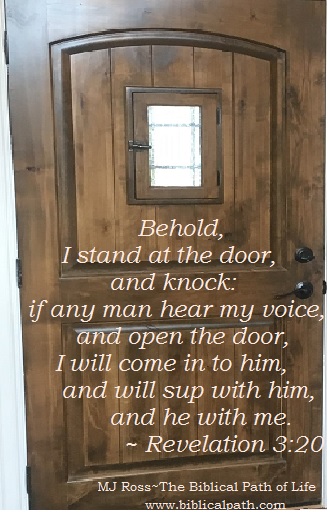
    But as we see in Revelation 3:20, Jesus is still available to any one who will open the Door (for Jesus is the Door, see John 10:7) to allow Jesus inside. He will come inside, and there can be sweet fellowship. “Behold, I stand at the door, and knock: if any man hear my voice, and open the door, I will come in to him, and will sup with him, and he with me” (Revelation 3:20).

    Are you someone who has allowed Jesus to be pushed out, forgetting why He came?

    Will you be willing to open the door and let Him back in?

    Make sure that you find a church that still faithfully presents the Gospel message of Jesus, the only way to be saved. Make sure that He is the primary focus of your life.

    He that hath an ear, let him hear what the Spirit saith unto the churches” (Revelation 3:22).

  • A Living Sacrifice

    “1. I beseech you therefore, brethren, by the mercies of God, that ye present your bodies a living sacrifice, holy, acceptable unto God, which is your reasonable service. 2. And be not conformed to this world: but be ye transformed by the renewing of your mind, that ye may prove what is that good, and acceptable, and perfect, will of God.”  Romans 12:1-2

    There are some very important things we need to learn about how a Christian is to live.     

    Paul encouraged people who have given their hearts and lives to Jesus to understand the importance of living their lives in a pleasing manner. Romans 12:1-2:  “1. I beseech you therefore, brethren, by the mercies of God, that ye present your bodies a living sacrifice, holy, acceptable unto God, which is your reasonable service. 2. And be not conformed to this world: but be ye transformed by the renewing of your mind, that ye may prove what is that good, and acceptable, and perfect, will of God.” Just as Jesus willingly died for each Christian, each Christian is then to present their life to Jesus as a “living sacrifice.” 

    What does this mean?  Living sacrifice means the physical life and existence, as opposed to death or nonexistence, always with some duration as a living and constant sacrifice. God expects His people to live a life, always, as if they belong to Him – acceptable to Him. That is the very least we can do (“reasonable service”). 

    Paul went on to remind us that because we are now spiritual creatures, we are not to be “conformed” to this world. 

    • Not conformed means to be fashioned alike; one is not to be molded by the external and fleeting manners or ways of this period of time, but to undergo a deep inner transformation that can only be brought by the Holy Spirit.  Instead of being conformed (changed to be like the world by outside influences), we are being transformed. 
    • Transformed means that invisible process that begins to take place in a Christian during his/her life here on earth.  To be changed from the inside out. How are we to be transformed?  By renewing one’s mind. 
    • Renewing means a renovation which makes a person different than in the past.  A Christian is not to think like they always have according to the world’s system.
    • Prove means to put to the proof or examine; the notion of proving a thing whether it is worthy or not.  Once Christians know how to live, they are to implement those things into their life.

    A Christian is to live a life, not like the rest of the world, but different from the world! We are to always remember that our life is not our own, for we have been bought with a price (1 Corinthians 6:20)!

  • Stand Fast

    Have you noticed that the world has changed? Did you also notice that things are not like they once were?

    What is different?

    Because Christians have not faithfully stood up for the truths of what the Bible teaches and the convictions that it brings, our word has changed.  It doesn’t appear that we have a voice in this world anymore.

    What does the Bible tell us we must do?

    “Watch ye, stand fast in the faith, quit you like men, be strong.” 1 Corinthians 16:13

    We must watch – stay awake and be vigilant.  The dangers, and sin, in our world are greater than many of us can bear. We have not been awake, watching, to prevent the godlessness of this world from becoming prevalent.

    Paul ended his letter to the Corinthian church with this warning.  He warned them to watch.  He told them to stand fast in the faith.  That meant he wanted them to be stationary, to persevere, in their convictions of the truth of God’s Word and the Gospel truth (their faith). They were not to compromise what God’s Word said.

    Is that an easy thing to do? Paul understood that many would not know how to do that. He encouraged them by telling them to be strong – much like a man has strength, and to use that strength to stand. Christians are to muster all of the strength we have deep down, take a stand, and not be moved from our convictions of what we know God’s Word tells us to do.

    Will you be one who will watch, not compromising, and stand fast in your faith?

  • Lesson 13 (Lesson 52): Jesus in the Old Testament: Jesus our Friend

    Key Verse

    “Greater love hath no man than this, that a man lay down his life for his friends.”  John 15:13

    Read the Key Verse with your class.  Ask your students if any of them have friends.  What characteristics make someone your friend? (i.e.: dependable, good listener, kind, always there, etc.)  Read today’s memory verse to your class.  Ask if any of them have a friend like that.  Would they, themselves, be the kind of friend that would lay down their life for another person?  The best friend in the world we could ever have is Jesus.  Today we will look at Jesus’ prayer in the garden on the night he was arrested.  Have them pay attention to what was on Jesus’ heart and mind as we read His prayer in the garden the night before He died on the cross.

    Summary:  We have been studying the five Personal Books of the Old Testament.  As we have learned, these books dealt with individuals’ very personal experiences with God.  We have been able to see some serious heart issues as these individuals sought to know and understand God better.  In studying them, we should now understand how very personal of a God we serve.  When these men cried out for answers, God answered.

    If you remember last week, we learned of a perfect love and compared it to a Christian’s love with God.  Just as God loved us and sent His Son, Jesus, we are to love Him with all of our hearts.  If our students can learn to love Jesus with all of their hearts, then their hearts will be prepared to one day love a man or a woman.  Remember, Christians are the bride of Christ (Ephesians 5:25:  “Husbands, love your wives, even as Christ also loved the church, and gave himself for it;”.  Compare this thought to today’s memory verse.)

    Today we will see the heart of Jesus revealed as He prayed in the garden on the eve of his arrest and crucifixion.  Just as the men who wrote the Personal Books laid their hearts open and bare for us to read about, Jesus’ prayer revealed the deepest and innermost thoughts of His heart.  Notice how He first dealt with himself, then his disciples He would be leaving behind, and finally with those who hadn’t believed upon Him yet – many of which hadn’t even been born yet (that is you and me.)  After this great prayer, we then look back at Psalm 22 which foretold of Jesus’ suffering death upon the cross, realizing Jesus knew He was about to lay down His life for His friends.  This is the greatest picture of a friend (see today’s key verse).  Jesus is the greatest friend because He gave up His life for me (and anyone who would believe).

    Just as we have been learning how to relate to God as the men who recorded the Personal Books, Jesus is our ultimate example of one who was not afraid to make His petitions known to God – knowing He would answer.  He is also a perfect example of the kind of friend we are to be to others.  Remember, the people He prayed for were the same people He gave His life for – His friends.

    Encourage your students to bring their Bibles and use them!

    Emphasis:  Jesus is our ultimate example of the kind of friend we are to be – willing to give all.


    Optional Worksheets to be downloaded:

    Lesson 52 – Volume 1 Children’s Worksheet 1

    Lesson 52 – Volume 1 Children’s Reinforcement Worksheet


    Ideas for children:

    Stickers always work well with children. Often times I watch Wal-Mart or Oriental Trading Company for specials or deals on things I can use for crafts for Sunday School (i.e. foam sheets, Bible Story scene stickers, crowns, stick on jewels, construction paper, etc.).  I keep a stash and when I need something, I go search in my stash!  Pinterest always has great ideas!

    You could have a coloring sheet that goes with the lesson.

    One idea for today’s lesson:  For today’s lesson give your students a blank piece of paper.  Have them write down some of their friend’s names.  Once they have finished this, have them think of something specific that they can pray about for each friend. (Examples:  maybe their friend is sick, or maybe they are on vacation, or maybe they are not very truthful and need prayer, maybe they have a friend who is especially mean to others and need prayer to help them be kinder, etc.)  Over all, encourage them to see needs in their own hearts and lives and the lives of others for which they can pray  Children, too, need to learn the importance of prayer.  And they will be encouraged and blessed as they see a prayer that they have written down answered!


    Mural idea:

    Refer to the wall in your classroom that has become a mural.

    By now your class should be in a groove as to the direction and areas in which they need to focus and work on to improve their Christian lives.  Use this knowledge to help you address specific areas in each lesson that your class can discuss and share as you add new things to your mural.  Continue to watch as your class grows in their knowledge of not only God’s Word, but areas in their lives that can be corrected, drawing them closer to the Lord.

    Have them each add anything else they may have brought to add to the wall.  Encourage everyone to participate.

  • Lesson 12 (Lesson 51): Song of Solomon: The Perfect Love

    Key Verse

    “The LORD hath appeared of old unto me, saying, Yea, I have loved thee with an everlasting love: therefore with lovingkindness have I drawn thee.”  Jeremiah 31:3

    Read the Key Verse with your class.  One thing almost every child learns from a very young age is that God loves them.  What they may not understand is that God’s love is an everlasting love to those who belong to Him.  In the world today, love is a much overused word.  We “love” hamburgers, fries, candy bars, football; the list is endless.  Today we want to help our students understand “perfect” love – a love that is everlasting.  The best example of a perfect love is the love God has for the world in sending His only Son, Jesus, to die for our sins (Romans 5:8).  Help your students understand the love God has for His people.  As we begin our lesson today, help them understand that this is the depth of the love God intended between a man and a woman.  Man is not complete, nor is a woman, without the other:  Genesis 2:18:  “And the LORD God said, It is not good that the man should be alone; I will make him an help meet for him.”  Today we will look at Solomon’s description of this kind of love.

    Summary:  Today we finish the Personal Books, concluding with the Song of Solomon.  Song of Solomon is a collective love song written by King Solomon as to a young maiden.  Within we find the beauty of a perfect love.  We will study the Song of Solomon from the basics of a man who loved a woman, and a woman who loved him.  Since we are teaching children, we will remind them that just as God loved us and sent His Son, Jesus, we are to love Him with all of our hearts.  If our students can learn to love Jesus with all of their hearts, then their hearts will be prepared to one day love a man or a woman.  Remember, Christians are the bride of Christ (Ephesians 5:25: Husbands, love your wives, even as Christ also loved the church, and gave himself for it;”).  Keep this thought in mind as we study the Song of Solomon, for the Song of Solomon is a picture of the love of Christ for his church, and the love the church should have for Christ, under the guise of a bride and groom.

    Encourage your students to bring their Bibles and use them!

    Emphasis:   To understand “true love” we must turn to God’s Word.  Just as Jesus loved us (his bride) so much He gave His life for them, we, too, are to love Him with all of our “heart, soul, mind, and strength” (Mark 12:30).  In loving Jesus, our hearts will be prepared to love one another (John 13:34).


    Optional Worksheets to be downloaded:

    Lesson 51 – Volume 1 Children’s Worksheet 1

    Lesson 51 – Volume 1 Children’s Reinforcement Worksheet


    Ideas for children:

    Stickers always work well with children. Often times I watch Wal-Mart or Oriental Trading Company for specials or deals on things I can use for crafts for Sunday School (i.e. foam sheets, Bible Story scene stickers, crowns, stick on jewels, construction paper, etc.).  I keep a stash and when I need something, I go search in my stash!  Pinterest always has great ideas!

    You could have a coloring sheet that goes with the lesson.

    One idea for today’s lesson:  For today’s lesson you could have your students cut out a very large heart from a red piece of construction paper.  They could either use markers to write or draw ways that we can show Jesus that we love Him.  (Ideas:  read and memorize verses from our Bibles, faithfully go to church, be kind to others, obey Mom and Dad, treat our brothers or sisters kindly, do something nice for someone else, help others, etc.)


    Mural idea:

    Refer to the wall in your classroom that has become a mural.

    By now your class should be in a groove as to the direction and areas in which they need to focus and work on to improve their Christian lives.  Use this knowledge to help you address specific areas in each lesson that your class can discuss and share as you add new things to your mural.  Continue to watch as your class grows in their knowledge of not only God’s Word, but areas in their lives that can be corrected, drawing them closer to the Lord.

    Have them each add anything else they may have brought to add to the wall.  Encourage everyone to participate.

  • Lesson 11 (Lesson 50): Ecclesiastes 9-12: The Conclusion of the Matter

    Key Verse

    “I am crucified with Christ: nevertheless I live; yet not I, but Christ liveth in me: and the life which I now live in the flesh I live by the faith of the Son of God, who loved me, and gave himself for me.” Galatians 2:20

    Read the Key Verse with your class.  Ask:  How can we be “crucified with Christ”? (By dying to our own selfish desires and living a life pleasing to God.)  Ask your students if they understand what it means when it says “nevertheless I live; yet not I, but Christ liveth in me.” (Once a person is saved, they are to no longer do what they want, because they are a sinful creature, but they are to do what Jesus wants them to do.)  In living a life “in the flesh I live by the faith of the Son of God”, means that even though we live here on the earth, in the flesh, we live a life of faith because we believe Jesus died on the cross, paying the penalty for our sins, so that we can live forever with him in heaven for eternity.  Encourage your students to keep this in mind as we continue our study of Solomon’s conclusions as we complete the book of Ecclesiastes.

    Summary:  Today we continue with the fourth of the Personal books, Ecclesiastes.  In our second week of studying the book, we remember that it was written by King Solomon, the man who had it all – riches, fame, rich heritage, a personal relationship with God, and wisdom beyond measure.  Remember he found that all of life is “vanity and vexation.” (vanityany thing that is futile, or worthlessvexationsomething that disturbs or annoys; to trouble seriously.)  Because Solomon had not learned how to restrain his desires he found they were the cause of all of his “vanity and vexation.”

    Last week we found King Solomon recognized the fool he had become in turning from God.  Even with all of his wisdom, Solomon did not have all of the answers of life.  We continue our study this week discovering other truths Solomon learned.  Solomon learned there are only two kinds of people; wicked or righteous.  God takes care of the righteous, but all people will one day die.  Only the righteous have hope (of eternity in heaven with Jesus).  After trying to make sense of life apart from God, Solomon found he couldn’t.  Solomon concluded, late in life, that it really is important what you do with your life.  He finally understood the importance of remembering the Creator in the days of your youth (while one is young in life) before evil takes root in ones life.  Once Solomon learned these very basic principles, he recorded them for all generations to come.  He found it so important to warn everyone that he ended the book of Ecclesiastes with these words:   Ecclesiastes 12:13-14:  “13. Let us hear the conclusion of the whole matter: Fear God, and keep his commandments: for this is the whole duty of man. 14. For God shall bring every work into judgment, with every secret thing, whether it be good, or whether it be evil.”

    Encourage your students to bring their Bibles and use them!

    Emphasis:  Man’s duty is to fear God and to keep His commandments.  Only in this will we please Him.


    Optional Worksheets to be downloaded:

    Lesson 50 – Volume 1 Children’s Worksheet 1

    Lesson 50 – Volume 1 Children’s Reinforcement Worksheet


    Ideas for children:

    Stickers always work well with children. Often times I watch Wal-Mart or Oriental Trading Company for specials or deals on things I can use for crafts for Sunday School (i.e. foam sheets, Bible Story scene stickers, crowns, stick on jewels, construction paper, etc.).  I keep a stash and when I need something, I go search in my stash!  Pinterest always has great ideas!

    You could have a coloring sheet that goes with the lesson.

    One idea for today’s lesson:  (See picture below).  For today’s lesson I found a coloring sheet with a cross with the words “How do I Follow Jesus”.  It had pictures such as going to church, reading the Bible and loving Him.  As we colored the picture, we discussed ways we can follow Jesus (i.e. obeying parents, choosing to do right, being kind one to another, etc.).  We also colored the verse from today’s lesson (the Children’s Reinforcement Worksheet).


    Mural idea:

    Refer to the wall in your classroom that has become a mural.

    By now your class should be in a groove as to the direction and areas in which they need to focus and work on to improve their Christian lives.  Use this knowledge to help you address specific areas in each lesson that your class can discuss and share as you add new things to your mural.  Continue to watch as your class grows in their knowledge of not only God’s Word, but areas in their lives that can be corrected, drawing them closer to the Lord.

    Have them each add anything else they may have brought to add to the wall.  Encourage everyone to participate.

  • Lesson 10 (Lesson 49): Ecclesiastes 1-8: The Vanity of Man

    Key Verse: “For what shall it profit a man, if he shall gain the whole world, and lose his own soul?”  Mark 8:36

    Read the Key Verse with your class.  Ask your students if they have ever desired the things of this world (everybody does – that’s part of our nature).  Is it OK to want stuff, here on this world? (Of course.)  The important thing is to not desire things more than pleasing God, and to do what is right according to God’s Word.  Should you lie, cheat, or steal to get something? (No.)  Should you want what “everybody” else has? (Not if it doesn’t please God.)  Because we live on this earth, we have to have “things” to live.  But, we have to be content with the things God gives us, and not make “things” as our primary focus.  Ask your students if they remember what is to be our “focus” (what we have our eyes set upon – Jesus).  We must be careful to not allow the desire for “the whole world” (see memory verse) to keep us from serving and pleasing God.  See as King Solomon learned this lesson as we begin Ecclesiastes today.

    Summary:  Today we begin the fourth of the Personal books, Ecclesiastes.  We will take two weeks to study the book.  The word, Ecclesiastes, means “the Preacher.”  Ecclesiastes was written by King Solomon, the man who had it all – riches, fame, rich heritage, a personal relationship with God, and wisdom beyond measure.  Yet with all of that, he found that all of life is “vanity and vexation.” (vanityany thing that is futile, or worthlessvexationsomething that disturbs or annoys; to trouble seriously.)  He repeats that phrase 7 times in Ecclesiastes.  Ecclesiastes 1:14:  “I have seen all the works that are done under the sun; and, behold, all is vanity (emptiness, something unsatisfactory) and vexation of spirit.”  Solomon had not learned how to restrain his desires and that was the cause of all of his “vanity and vexation.”

    Watch as King Solomon recognized the fool he had become in turning from God.  See as Solomon set about to prove he could be happy in this world, but ended up proving the worth of the wisdom from God. He also learned to be careful in his worship of God.  Finally, today, we see that man cannot understand God, we just have to fear him.  In doing this, we can know him.

    Even with all of his wisdom, Solomon did not have all of the answers of life.  He wrote this book from a worldly man’s point of view.  He tried to make sense of life apart from God, yet couldn’t.

    Encourage your students to bring their Bibles and use them!

    Emphasis:  Man cannot be satisfied with the things of the world.  He must seek God, and wisdom from God.  We cannot understand God, but “fear of the LORD is the beginning of knowledge.”


    Optional Worksheets to be downloaded:

    Lesson 49 – Volume 1 Children’s Worksheet 1

    Lesson 49 – Volume 1 Children’s Reinforcement Worksheet


    Ideas for children:

    Stickers always work well with children. Often times I watch Wal-Mart or Oriental Trading Company for specials or deals on things I can use for crafts for Sunday School (i.e. foam sheets, Bible Story scene stickers, crowns, stick on jewels, construction paper, etc.).  I keep a stash and when I need something, I go search in my stash!  Pinterest always has great ideas!

    You could have a coloring sheet that goes with the lesson.

    One idea for today’s lesson:  (See picture below).  For today’s lesson I found copy of a treasure box online that we could color, cut out and glue together.  We discussed the idea that even with all of the treasures and resources that King Solomon had, he was not happy.  He found that he had to seek God first in order to be satisfied.  Remind them that gaining a lot of stuff (treasures to us) is not as important as seeking God and pleasing Him.  King Solomon learned this the hard way!


    Mural idea:

    Refer to the wall in your classroom that has become a mural.

    By now your class should be in a groove as to the direction and areas in which they need to focus and work on to improve their Christian lives.  Use this knowledge to help you address specific areas in each lesson that your class can discuss and share as you add new things to your mural.  Continue to watch as your class grows in their knowledge of not only God’s Word, but areas in their lives that can be corrected, drawing them closer to the Lord.

    Have them each add anything else they may have brought to add to the wall.  Encourage everyone to participate.