Tag: Year Three

  • Lesson 7: Jesus’ Teachings: The Four Gospels

    Key Verse

    And he said unto them, Let us go into the next towns, that I may preach there also: for therefore came I forth.  

    —Mark 1:38

    Key Verse Thought: Before considering the Key Verse, read the following verses: “35. And in the morning, rising up a great while before day, he went out, and departed into a solitary place, and there prayed. 36. And Simon and they that were with him followed after him. 37. And when they had found him, they said unto him, All men seek for thee. 38. And he said unto them, Let us go into the next towns, that I may preach there also: for therefore came I forth. 39. And he preached in their synagogues throughout all Galilee, and cast out devils” (Mark 1:35-39).    It is important to emphasize verse thirty-eight, the Key Verse for this lesson. This verse helps us understand one very important reason as to why Jesus came – to preach to the people. In this lesson, we will read some of those teachings. First and foremost we will understand that people are to believe in Jesus and confess Him, becoming saved (a Christian). As you consider this lesson, recognize who it is Jesus says to believe like (we will see in Mark 10:13-16). 

    Emphasis: Jesus came to preach to the people.  First, to call them to Himself, then to teach them the many commands they were to obey, allowing God to manifest Himself to Believers.  Once a Christian knows what Jesus’ teachings are, that person is to obey them.

    Lesson Summary: After reading about the twelve apostles (disciples) who walked with Jesus, learning from Him, we read of many of Jesus’ Miracles where some believed and followed Him. Jesus taught many parables, in which He taught His followers heavenly things, and more people believed. 

    In this lesson, we learn about some of Jesus’ teachings. First, we find that of all the people who saw the miracles of Jesus and heard His parables, many still did not believe. Nevertheless, Jesus drew attention to what it takes to believe in Him – one must come to Him much like a child and just believe. Next, we will look at parts of Jesus’ “Sermon on the Mount.” Jesus had much practical advice of how to live, but He had many specific things Believers were supposed to do:  let our light shine; not be angry; love our enemies; learn how we are to pray; place our treasures in heaven; seek God’s kingdom first; learn for what we are to ask, seek and knock; learn that broad is the path and narrow is the way; ending with a culmination of all of Jesus’ teachings in a true application by the wise builder compared to a foolish man who rejected Jesus and His teachings.    We will then read about a rich man and Lazarus, and see the difference in the lives, and even the deaths, of these two men. Finally, we will learn just what it is Believers are to do after hearing Jesus’ Teachings. Notice that even today, Jesus’ Words call man to a time of decision – to believe or to not believe.

    Y3Q1 – Lesson 7 Questions

    Y3Q1 – Lesson 7 Children’s Worksheets

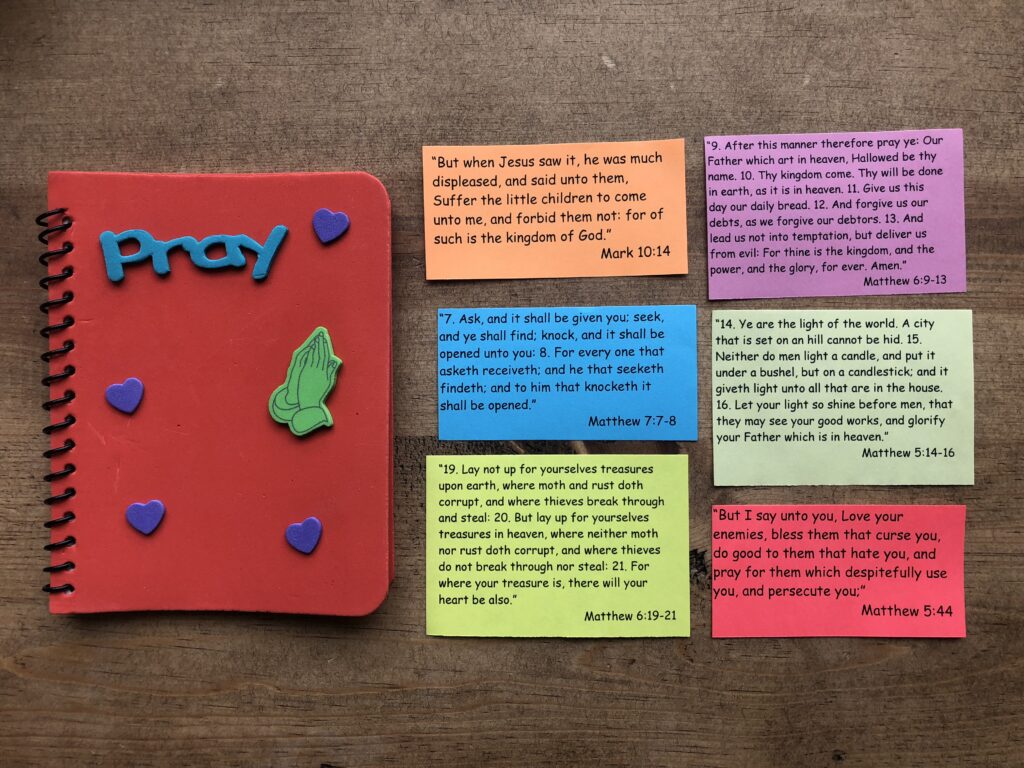
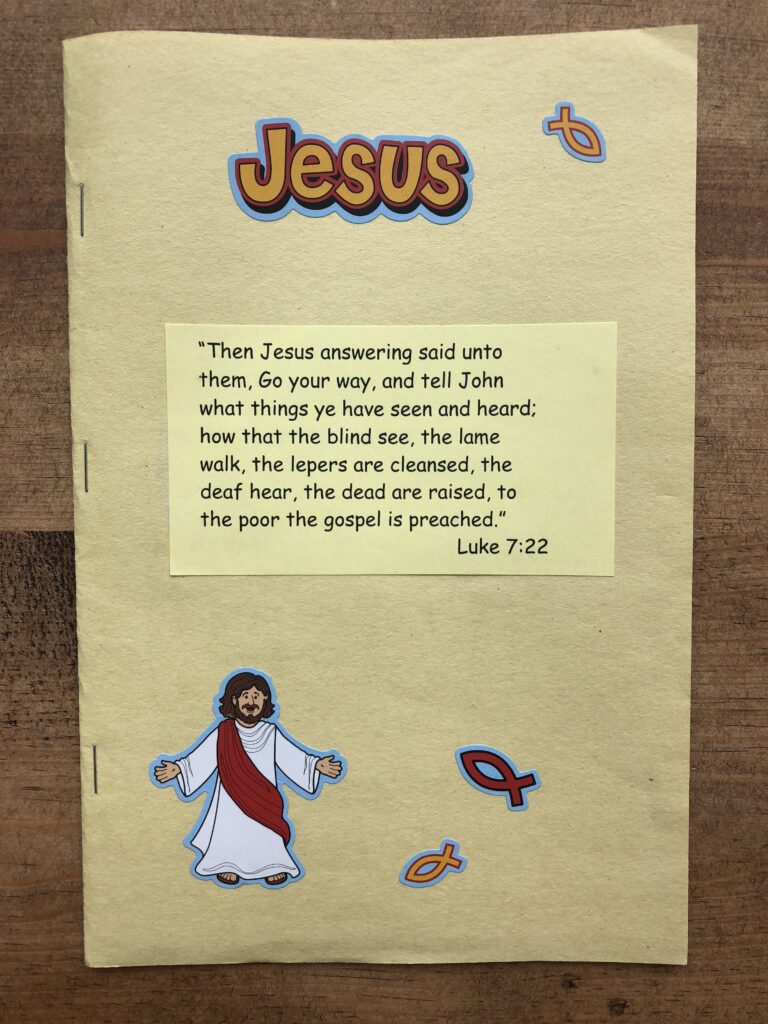
    The following is a craft idea if you are teaching younger children.

    We made a book and glued different verses inside to help us remember some of Jesus’ teachings. We then decorated the cover. Students were encouraged to write more verses in their books.

  • Lesson 6: Jesus’ Parables: The Four Gospels

    Key Verse

    And he said unto them, He that hath ears to hear, let him hear.

    —Mark 4:9

    Key Verse Thought: Read today’s Key Verse. Everyone has ears. What do we use our ears for? (i.e.: to hear; hold glasses; etc.). We are to understand the primary purpose for our ears is to hear. In this lesson, we will learn that Jesus taught by parables. Parables are “earthly stories with heavenly meanings.” Jesus wanted His followers to understand His teachings. He wanted them to put on their “spiritual ears” and not only hear what He taught, but to do what He taught.     

    Emphasis: In this lesson, we are to understand that God’s Word is the seed and once the seed is planted, it is to grow, producing fruit. That means that once we hear about Jesus and become a Christian, we are to live a life pleasing to Him. Christians have the ears that are to hear the truths taught by Jesus and live accordingly.

    Lesson Summary: In our last lesson, we learned about a few of the miracles of Jesus. In those miracles we saw the compassion of Jesus and the call to faith – to believe in Jesus. 

    In this lesson, we will learn that Jesus taught in parables. Parables are often referred to as “earthly stories with heavenly meanings.” Jesus told many parables, but we will only look at a few today: the Sower and the seed; the parable of the Good Shepherd; the parable of the Good Samaritan; the parable of the lost sheep, the lost coin, and the lost son; ending with the parable of the prayer of the Pharisee and the publican. 

    In the first parable Jesus taught (the Sower and the seed), it revealed that Jesus is the Sower, and the seed is the Word of God. The people who received the Word of God grew and produced fruit. He ended with the phrase, “He that hath ears to hear, let him hear” for it was a call for anyone who would to receive God’s word and be saved. When the disciples asked why Jesus taught in parables, Jesus explained it to them. He wanted His followers to understand what He was teaching. 

    Some of today’s parables may be familiar to you, but try to understand what Jesus was teaching his followers. Even those who did not fully understand were called to make a decision – to follow Jesus and His teachings, or not.  In these parables Jesus taught not only how be saved, but that once saved, a Christian is to grow. Jesus also taught there is only one way to Heaven – Jesus.

    Y3Q1 – Lesson 6 Questions

    Y3Q1 – Lesson 6 Children’s Worksheets

    If you are teaching this to younger children, we planted seeds in a small pot for this lesson to remind them of the parable of “The Sower and the Seed.”

  • Lesson 5: Jesus’ Miracles: The Four Gospels

    Key Verse

    “Then touched he their eyes, saying, According to your faith be it unto you.”

    —Matthew 9:29

    Key Verse Thought: After reading the key verse, try to understand the word faith. Faith means “faith in Christ as able to work miracles, healing the sick; the means of appropriating what God in Christ has for man resulting in the transformation of man’s character and way of life – also called Christian faith.” Today we are going to learn what Jesus was able to do in the lives of the people who had faith in Him.    

    Emphasis: We are to remember the compassion Jesus had for the lost world, and that he revealed the need for forgiveness of sin. Christians are to have the same compassion for the lost world, wanting to see them come to know Jesus. We are to live a Christian life, and bring our friends to meet Jesus.

    Lesson Summary: In our last lesson, we learned about Jesus’ disciples (specifically the 12 apostles). They were to be Jesus’ ambassadors in this world. Jesus sent them out preaching and healing. More than that, Jesus spent time teaching and training these men.

     In this lesson, we will look at a few of the miracles of Jesus. There are too many miracles of Jesus to talk about in one lesson, so we will only look at a few: Jesus healed a leper; Four friends and a man with palsy; The man with a withered hand; The centurion’s servant; The raising from the dead of the widow’s son in Nain; Jesus stilled the tempest; Raised Jairus’ daughter and healed the woman with an issue of blood; Made two blind men to see; Jesus walked on water; A gentile woman’s daughter healed; Feeding of 4000; Jesus healed ten lepers; and Jesus gave sight to blind Bartimaeus.

    As we look at some of the miracles of Jesus, notice that He did them for a reason. As we read these events, we will learn some of those reasons. Sometimes Jesus had compassion on the people. In other instances, they were to draw attention to the faith: either the presence of faith, the lack of faith, or even no faith at all. Nevertheless, in most of these instances, we will recognize the call to action – to believe, or not to believe. That decision comes from not only the person, or persons, directly involved, but also the bystanders. We will then witness the transformation of lives that had faith.

    Remember: Keep in mind that these lessons will not necessarily be in a chronological order of the life of Christ. We will focus on a few of the miracles of Jesus.

    Y3Q1 – Lesson 5 Questions

    Y3Q1 – Lesson 5 Children’s Worksheets

    If you are teaching this to younger children, the following is a craft idea. We made a coloring book of a few of Jesus’ miracles. This is to help them remember some of what was read in this lesson.

  • Lesson 4: Jesus’ Disciples: The Four Gospels

    Key Verse

    And he saith unto them, Follow me, and I will make you fishers of men.

    —Matthew 4:19

    Key Verse Thought: Read today’s key verse. Have you ever been fishing? Did you have to fish a long time before catching any fish? Did you have the patience? Was it easy? Jesus called some men to leave their fishing nets to go and tell people about Jesus. Instead of fishing for fish, Jesus would teach them how to fish for men. They had to understand it would take a lot of time and patience. It wouldn’t always be easy.

    Emphasis: We are to recognize Jesus is God’s Son and follow Him. It is then important to share the good news of Jesus with our friends and family – just as Jesus’ disciples did. Christians are to be fishers of men.

    Lesson Summary: In our last lesson, we watched as John the Baptist’s ministry began to decrease, and the fame of Jesus began to spread. Jesus had declared to the people in his hometown of Nazareth that He was the Promised One. They rejected Jesus, and He left Nazareth but continued preaching. 

    In this lesson, we will read that when John the Baptist saw Jesus again, he declared that Jesus was the Lamb of God. When some of the followers of John heard this declaration, they followed Jesus. Andrew was one, and he found his brother, Simon, and brought him to Jesus. Jesus also called Philip (who brought Nathanael to Jesus). Herod threw John the Baptist into prison. Other men who had followed John chose to follow Jesus instead. In Galilee, many people followed Jesus, listening to His teachings. Jesus came to the shore and saw empty fishing boats. Jesus had Simon take Him out from the shore – so He could preach to the crowds. While out on the boat, Jesus told the fishermen to cast out their nets. They had fished all night and caught nothing, but at Jesus’ words, they cast out the nets. They caught so many fish the nets broke and the ships were sinking. Jesus called these men to leave their fishing nets to follow Him, and He would make them fishers of men. They followed Jesus.

    Jesus went on to call Philip (who brought Nathanael to Jesus), and Matthew (who invited Jesus to dinner – along with many of his lost friends). However, the religious leaders of the day began to show their hatred for Jesus and started planning what they might do to Him.

    Jesus saw the need of the people, and He recognized many laborers were needed. He prayed all night, and then called twelve apostles (who would be His witnesses to the world). After Jesus instructed the apostles, he sent them out to preach and heal. Jesus went out with his disciples preaching and healing.

    In this lesson, we will learn some of the things Jesus taught His disciples: when Jesus told them to feed the crowd of more than five thousand with five loaves and two fishes, and also when Jesus asked who people said He was.

    Y3Q1 – Lesson 4 Questions

    Y3Q1 – Lesson 4 Children’s Worksheets

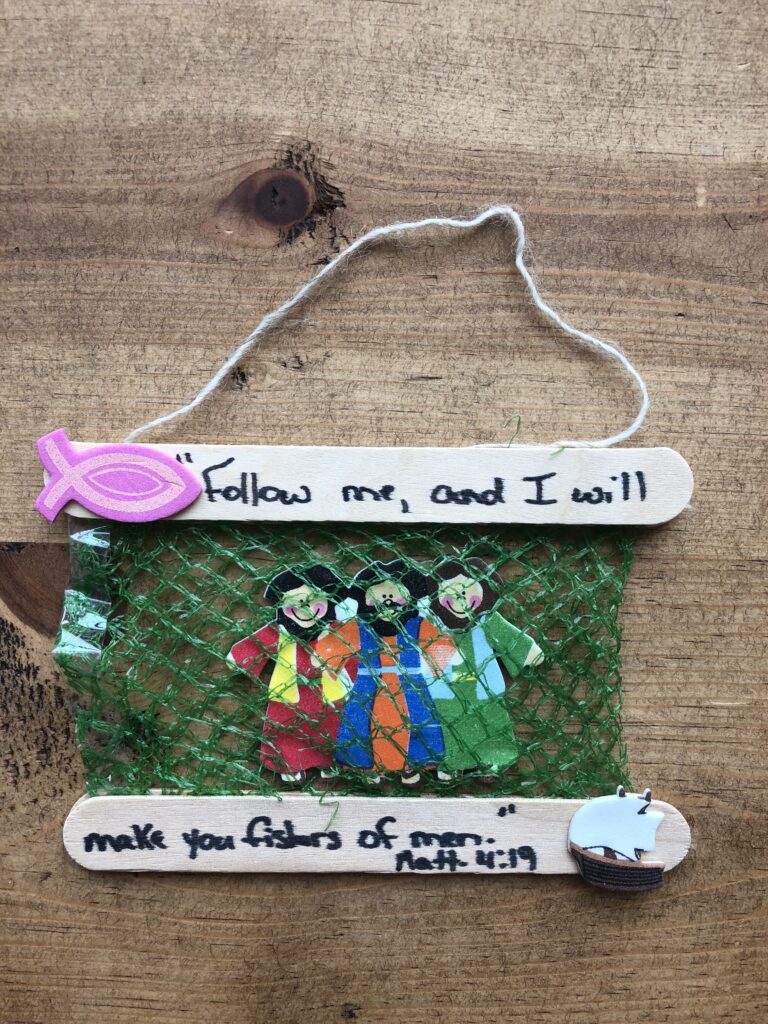
    To help them remember today’s lesson, we made this to remind them that Jesus called His disciples to become fishers of men.

  • Lesson 3: John the Baptist Introduces Jesus: The Four Gospels

    Key Verse

    The voice of him that crieth in the wilderness, Prepare ye the way of the LORD, make straight in the desert a highway for our God.

    —Isaiah 40:3

    Key Verse Thought: After reading today’s Key Verse, remember the baby John that we learned of in our last lesson. In this lesson, we will learn that he was the one Isaiah wrote about hundreds of years earlier: the voice of one crying in the wilderness. We will begin to understand that he was sent by God to do a special job – to prepare the way for Jesus.

    Emphasis: God has a plan for each Christian’s life. We may not understand exactly why God has us do something (remember John baptizing), but we are to obey anyway – just as John did. Moreover, we have Jesus as our example of how to defeat temptations – by knowing God’s Word.

    Lesson Summary: In our last lesson, we looked at the births of John and Jesus. God sent angels to tell about both of these special births. We also learned about Jesus’ childhood. In this lesson, we will find out more about John that was born. 

    John grew up in the wilderness, and at about thirty years of age, he came out of that wilderness preaching, “Repent ye: for the kingdom of heaven is at hand” (Matthew 3:2).  His job was to prepare the way for the Promised One. Although John did not know who the Promised One was, God instructed him to baptize, and He would reveal that One to him. And John obeyed. He became known as “John the Baptist.”  God revealed the Promised One to him with the Spirit of God in the form of a dove which lighted upon Jesus as he came up out of the water after baptism. Jesus, too, was about thirty years of age.  

    Immediately, Jesus was driven into the wilderness where Satan tempted him with three specific temptations. Jesus defeated each of those temptations by quoting God’s Word. When Satan left Jesus, angels ministered to Him. When John the Baptist saw Jesus again, He introduced Him to all as “the Lamb of God, which taketh away the sin of the world” (John 1:29). At this point, John’s ministry started to decrease, and Jesus’ ministry began.

    Jesus went to Galilee where his fame was spread abroad. He then returned to his home town of Nazareth where He went to the synagogue. Once there, Jesus stood to read. He was given the book of Isaiah. He read the Scripture that was a prophecy of the Messiah who was to come. When Jesus finished reading, He declared that those words had been fulfilled in their ears – in other words, Jesus was that One promised. This angered the people, and they tried to kill Jesus. “From that time Jesus began to preach, and to say, Repent: for the kingdom of heaven is at hand” (Matthew 4:17).

    Y3Q1 – Lesson 3 Questions

    Y3Q1 – Lesson 3 Children’s Worskheets

    If you are teaching this to younger children, this is an idea of a craft to help them remember this lesson.

  • Paul’s Encouragement and Warning

    We then that are strong ought to bear the infirmities of the weak, and not to please ourselves.
    Romans 15:1

    Excerpt from Y3Q2 Lesson 10: Paul’s Third Missionary Journey:

    “The leaders in the church of Ephesus, of whom Paul had called to himself to speak, needed to realize that Paul would no longer be there physically to rely upon. They had to step up and take care of God’s church. “… 27. For I have not shunned to declare unto you all the counsel of God. 28. Take heed therefore unto yourselves, and to all the flock, over the which the Holy Ghost hath made you overseers, to feed the church of God, which he hath purchased with his own blood” (Acts 20:25-28). Paul had done the job God had given him to do: he declared to all of the people the counsel of God (counsel means “God’s purpose, or plan”). He had taught them. Knowing that Paul would not be able to return to them, these men had to be prepared. “29. For I know this, that after my departing shall grievous wolves enter in among you, not sparing the flock. 30. Also of your own selves shall men arise, speaking perverse things, to draw away disciples after them” (Acts 20:29-30). They must not only be prepared themselves, but they must take care of, and prepare, the church over which they were the leaders. Not only would some (“grievous wolves”) come in and try to destroy new Christians, as well as the church, but also there would be leaders arise that would be filled with “perverse things” (perverse things means “perverted; corrupt; vicious; or ‘to turn aside divine truth’”). Some leaders would try to cause people to follow them – not Jesus. What were they to do? “31. Therefore watch, and remember, that by the space of three years I ceased not to warn every one night and day with tears. 32. And now, brethren, I commend you to God, and to the word of his grace, which is able to build you up, and to give you an inheritance among all them which are sanctified” (Acts 20:31-32). They were to do just as Paul had done – for he had lived his life as an example. Paul warned that after teaching the new Christians how to live a Christian life (following Jesus), they would then have to warn the people, day and night, of these “grievous wolves” who would come “speaking perverse things” and to recognize them. Also, see what else Paul revealed. “I have shewed you all things, how that so labouring ye ought to support the weak, and to remember the words of the Lord Jesus, how he said, It is more blessed to give than to receive” (Acts 20:35). Support means “to take hold of another mutually as by the hand; i.e. figuratively to support from falling as by the hand; to support, help, assist.” Weak means “without strength, powerless; weak; to be afflicted, distressed as by want, oppression, calamity, and such.” Newer Christians (as well as newer churches) need extra support, for they are weak in their new Christian life. Many new Christians (and even some older ones) are often afflicted and distressed by their want (things they desire, or want, as opposed to things God would have for them), or even what seems to be a calamity in their life. Paul warned that these people needed “support from falling as by the hand,” or assistance, from stronger Christians.

    “After teaching them face-to-face one last time … one cannot help but recognized the impact that Paul had upon these Christians’ lives. These people loved Paul for the life he had lived, faithfully teaching them the things of Jesus.

    “A Deeper Path: It is the responsibilities of church leaders to help new Christians (those who are “weak”) grow in Christ. However, it is not only the responsibility of the leaders, but it is the duty of all Christians. See the following verses. “1. We then that are strong ought to bear the infirmities of the weak, and not to please ourselves. 2. Let every one of us please his neighbour for his good to edification” (Romans 15:1-2). That are strong means “one who is strong, firm, fixed, established” – referring to the things of Christ. Infirmities means “to be weak or powerless; the result of being weak: i.e. referring to the scruples which arise by being weak in the faith of Jesus.” As Christians, we are not to please ourselves, for we must always remember that there are newer Christians who may not understand the things we do – for a newer Christian may not always know what the right thing to do in a situation is. It is the responsibility of every Christian to live a life according to God’s Word, so that newer Christians are not confused. We are to live a life that is right “for his good to edification.Good means “good, in respect to operation or influence on others; i.e.: useful, profitable, beneficial.” Edification means “building as a process; i.e.: edification, spiritual profit or advancement.” Christians are to live lives that cause other Christians to become better Christians by living a life that pleases Jesus.”

    Do you live a Christian life that helps newer Christians understand how to please Jesus, growing stronger?