And ye shall seek me, and find me, when ye shall search for me with all your heart.
—Jeremiah 29:13
Key Verse Thought: Read today’s key verse. Do you know what it is
to seek for God? Use the following definitions to help you understand this
verse:
seek: to search out – specifically in prayer or worship; to
enquire, ask, beseech
search: to follow in pursuit; to search; to worship; make
inquisition
find: to find or acquire; to meet
heart: the mind; understanding
God promises that if we will
actively pursue Him in prayer or worship, we will meet Him. But only if we will
follow in pursuit until we find Him with our mind and understanding. It
obviously takes work. In this lesson, we will see that the people of Israel
did not seek God – even when God told them to seek Him.
Emphasis: We should consider Amos’ question. “Can two walk together, except they be agreed?” (Amos
3:3). We cannot live as the Israelites lived, disregarding God’s commands. We
should then heed Amos’s warning to “Seek the LORD,
and ye shall live…” (Amos 5:6).
Lesson Summary: Amos was a contemporary of Jonah, whom we studied in
our last lesson. Although they spoke around the same time, they spoke God’s
Word to different groups of people. If you remember, God sent Jonah to a city, Nineveh,
in a Gentile nation, Assyria. Amos was from an area just
south of Jerusalem, in Judah.
But God sent him to speak – mostly to Israel.
He spoke during the reign of King Jeroboam II.
Amos was known as a prophet from the country. He was only a herdsman, yet when God called him, he obeyed God (Amos 7:14–15). Amos told of the impending judgment on the nations around, ending with the judgment that would fall upon Israel for their sin against God. He asked a pertinent question. “Can two walk together, except they be agreed?” (Amos 3:3).
After many warnings to “[s]eek the LORD, and ye shall live …”, Amos warned of the discipline God would allow upon the people of Israel if they refused to turn back to Him. When the people refused to heed correction, God showed Amos several things that revealed the judgment that would come to God’s people. He saw: grasshoppers, a plumb line, a basket of summer fruit, and finally God standing at the altar. Nevertheless, even with the impending doom, God left His people with words of hope and restoration.
If you teach this to children, here is a craft idea:
You could have your students make a picture of a sheep to remember Amos was a herdsman. Have them glue cotton, draw a face on the sheep, and add the verse Amos 1:1a.
For the grace of God that bringeth salvation hath appeared to all men. —Titus 2:11
Key Verse Thought: Read today’s key verse. Use the following
definitions help you understand it:
grace: the divine influence upon the heart;
appeared: become visible; able to be known.
Today we are going to study a prophet that God
sent to a Gentile nation (they were not Israelites, God’s chosen people). God
makes His salvation known to all who need it.
Emphasis: Be encouraged to know where God wants you to be, and
to be
where God wants you to be. Also, to be a faithful witness wherever you may
be.
Lesson Summary: As we continue studying the Historical Books, we
will intermittently study a book of the Prophets as close to the timeframe in
history we are studying as we can. We have learned of the deplorable condition
of the nation Israel
as they only had bad kings. None of them led the nation in reformation back to
the one, true God. We have remembered two very influential prophets of the
Lord, Elijah and Elisha. Today we will look at another prophet, Jonah. Unlike
Elijah and Elisha who spoke the Word of the Lord to the people of Israel,
God sent Jonah to a nation that was the enemy of Israel.
King Joash (Jehoash) was the last king in Israel
of which we read (we will continue with his reign in Lesson 8). Jonah came upon
the scene after King Joash (Jehoash) and during the reign of the next king of Israel,
Jeroboam II (who we will study in Lesson 8 — see 2 Kings 14:23, 25).
Jonah is a book in the Bible that is very familiar. One in which many people could probably relate without even having to go back and reread the book of Jonah. With that thought in mind if you are teaching a group, prepare to teach your students something about Jonah they may have never considered before. Be encouraged to never become so familiar with an account in the Bible that you don’t want to “hear it again.”
Understand and know that the events that transpired in Jonah really happened. Jesus even compared Himself to the prophet Jonah (called Jonas in the Greek). “39. But he answered and said unto them, An evil and adulterous generation seeketh after a sign; and there shall no sign be given to it, but the sign of the prophet Jonas: 40. For as Jonas was three days and three nights in the whale’s belly; so shall the Son of man be three days and three nights in the heart of the earth. 41. The men of Nineveh shall rise in judgment with this generation, and shall condemn it: because they repented at the preaching of Jonas; and, behold, a greater than Jonas is here” (Matthew 12:39–41). Proof enough to anyone that Jonah was a real prophet who spent three days and three nights in the belly of a whale.
There are many options to show the events from the book of Jonah. I had extra stickers from other projects and made my own picture to remember what happened to Jonah.
“Moreover it is required in stewards, that a man be found faithful.” 1 Corinthians 4:2
There are many people in our lives with whom we become
acquainted. However, one must be cautious that those we spend the most time
with have a true knowledge of Jesus and a love for God’s Word. We are to
understand that words alone do not make one a child of God. A very dangerous
position in which to be is to be one who does not hold the truth
of salvation. What is the condition of those who do not have a true knowledge
of Jesus? “12. These are spots
in your feasts of charity, when they feast with you, feeding themselves without
fear: clouds they are without water, carried about of winds; trees whose
fruit withereth, without fruit, twice dead, plucked up by the roots; 13.
Raging waves of the sea, foaming out their own shame; wandering stars, to whom
is reserved the blackness of darkness for ever” (Jude 1:12-13). When
one does not hold the truth of salvation, they might just look and sound
like a Christian, yet they have never known the truth of the Gospel message.
What a sad place to be! Remember the warning Jesus gave: “21. Not every one
that saith unto me, Lord, Lord, shall enter into the kingdom of heaven; but he
that doeth the will of my Father which is in heaven. 22. Many will say to me in
that day, Lord, Lord, have we not prophesied in thy name? and in thy name have
cast out devils? and in thy name done many wonderful works? 23. And then will I profess unto them, I
never knew you: depart from me, ye that work iniquity” (Matthew 7:21-23).
Remember an event in the New Testament to help one understand
this better.
Paul had met a couple, Aquila and
Priscilla, while on his second missionary journey in the city of Corinth.
Paul taught in the synagogue every Sabbath, teaching the people that Jesus was
the Christ (the Messiah that had come to take away the sin of anyone who would
believe). Eventually, the chief ruler of the synagogue “believed on the Lord with all his house;
and many of the Corinthians hearing believed” (see Acts 18:8). Paul
stayed there for a time, teaching the Word of God to the people. When he left Corinth,
Priscilla and Aquila went with him until he reached Ephesus
where they stayed while Paul continued on his journey.
While Priscilla and Aquila were there,
a man came. “And a certain Jew named
Apollos, born at Alexandria, an eloquent man, and mighty in the scriptures, came to Ephesus” (Acts
18:24). See what else God’s Word
says of Apollos. “This man was instructed
in the way of the Lord; and being fervent in the spirit, he spake and taught
diligently the things of the Lord, knowing only the baptism of John”
(Acts 18:25). One has to stop for a minute to remember what it means by the
“baptism of John.” John (also known as John the Baptist) was preaching
repentance, calling for people to be baptized, preparing them to receive Jesus
when He came. John the Baptist’s job was to “make ready a people prepared for
the Lord” (see Luke 1:17b). This meant that he was to introduce Jesus to the
people as the Messiah (the Christ) for whom they had been waiting. “The next day John seeth Jesus coming unto
him, and saith, Behold the Lamb of God, which taketh away the sin of the world”
(John 1:29). Somehow, Apollos missed
that part of the message. He only knew of the baptism to repentance, but missed
that Jesus was the Lamb of God, which takes away the sin of the world. He had
knowledge of much of the Scripture, but he was missing the key part – Jesus. Repentance
of sin was important, but it was meaningless unless one understood that Jesus
was the One who took the sin from the individual, giving salvation.
What was Apollos doing with the information of the baptism to repentance that was taught by John the Baptist? “And he began to speak boldly in the synagogue: whom when Aquila and Priscilla had heard, they took him unto them, and expounded unto him the way of God more perfectly” (Acts 18:26). When Aquila and Priscilla heard that what Apollos was teaching was missing the most important part (Jesus), they went to him and “expounded unto him the way of God more perfectly.” What does that mean? They explained to Apollos that Jesus was the Christ. “But these are written, that ye might believe that Jesus is the Christ, the Son of God; and that believing ye might have life through his name” (John 20:31). They had to tell Apollos about Jesus. “Moreover it is required in stewards, that a man be found faithful” (1 Corinthians 4:2). That was the key part of the message that Apollos had not yet heard. However, when Apollos heard, he believed in Jesus. How do we know that he received the message and believed in Jesus? “For he mightily convinced the Jews, and that publickly, shewing by the scriptures that Jesus was Christ” (Acts 18:28). Because Aquila and Priscilla were faithful stewards of God’s Word, not only did Apollos believe, but he proceeded to tell others that Jesus was the Christ, too.
Have you told others that Jesus is the Christ, and that by believing they can have life through His name?
Keep thy heart with all diligence; for out of it are
the issues of life.
—Proverbs 4:23
Key Verse Thought: As you read the Key verse for this lesson, use
the following definitions to help you understand it a little better.
keep: guard; protect;
preserve
heart: the center; the
totality of man’s inner nature; the place where wisdom and understanding reside
We are to be very careful of what we allow
into our hearts. We should protect not only the nature (character, or
attributes) but also the wisdom that we allow into our hearts. Why? What we
allow into our heart is the source for the kind of life we live; the kind of
person we become. That is one reason why when someone becomes saved; we say
they have asked Jesus into their heart.
Be encouraged to consider
your heart as the place where a special treasure is kept — a place to be well
guarded. It would also be good to understand the importance of placing God’s
Word into your heart (see Psalm 119:11).
Emphasis: We are to learn from the failings of King Jehu. We are to
keep our hearts with all diligence — always continuously hiding God’s Word in
our hearts so we will know what to do (unlike King Jehu).
Lesson Summary: As we begin this lesson, we must remember that
Jehoram (also called Joram) reigned in Israel.
Elisha had sent one of the prophets to anoint a new king of Israel,
Jehu, even while Jehoram was still king. When Jehu was anointed, he was also
given a very grave message. He was to kill Ahab’s entire household.
We will see the process that Jehu followed being established as the new king of Israel. Jehu went to Jezreel and killed King Jehoram (and Ahaziah, king of Judah, who was visiting King Jehoram). He continued by having Jezebel killed. Ahab had 70 sons living in Samaria, and they were also killed. Jehu did not stop there, he continued by killing every Baal worshiper in Israel. He then had all of the images burned, and they broke down the house of Baal. When Jehu died, we find his son, Jehoahaz, becomes the twelfth king of Israel. He reigned for 17 years in Israel, and “followed the sins of Jeroboam.” It was a greatly oppressed nation while he was king. When he died, his son, Joash (Jehoash), became the thirteenth king of Israel.
As we read about all of the good that Jehu did, we will find an area in which he miserably failed. This is to be a lesson to us.
You could have them make a journal including verses reminding them the importance of fearing the Lord and walking in His ways. That was Jehu’s failure – although he did much for God, he did not walk in God’s ways.
For ye have need of patience, that, after ye have done the will of God, ye might receive the promise. —Hebrews 10:36
Key Verse Thought: After
you read the Key Verse, use the following definitions to help you understand it
better.
patience: endurance; perseverance or constancy under suffering in
faith and duty
will: purpose; God’s law; decree
promise: salvation in Christ
Does one really understand patience? Does it take patience
to do something that doesn’t always make sense? For example (here are a few
examples, or you may thing of some better ones!):
Making your bed when you’re going to sleep in it that night — it keeps your room neat and your covers straight;
Going to bed at a regular bedtime even though you still have work to do — keeps you from always being tired or rundown which allows you to get sick easier;
Eating foods that are good for you, as opposed to junk food all of the time — also keeps you healthier;
Submitting to your authority, even though you think you know best!
Today we will see many people who were asked to do things
that didn’t necessarily make sense to them at the time. The important thing for
them to learn was to do what the prophet of the Lord told them to do, obeying
God’s Words. We will also see what happened for those who patiently did the
will of God and see what God gave them.
Emphasis: In this lesson, we should learn to obey God’s Word,
patiently, even if it seems too hard or it does not necessarily make sense to
us. Be encouraged to put your faith and trust in Jesus and to live your life
according to God’s Word.
Lesson Summary: In this lesson, we will continue learning the history of the nation Israel, the Northern Kingdom. Once we saw Elijah taken, we read Elisha established as the prophet of the Lord. Elisha had requested Elijah to give him a double portion of Elijah’s spirit. In this lesson, we will see that this is just what Elisha received. Not only did he have dealings with many Israelites, but we will also see that he took the Word of the Lord to the kings. His fame even spread by an Israelite maiden taken captive into the home of a captain in the Syrian army. His name was Naaman. Because he obeyed the words spoken by the prophet of the Lord, Elisha, Naaman was healed of his leprosy. Notice the many different, and even unusual things, people were asked to do, obeying the words of the prophet of the Lord. It would also be good to notice the blessings, and even the salvation from the enemies, the people received when they obeyed.
“6. Seek ye the LORD while he may be found, call ye upon him while he is near: 7. Let the wicked forsake his way, and the unrighteous man his thoughts: and let him return unto the LORD, and he will have mercy upon him; and to our God, for he will abundantly pardon.” Isaiah 55:6-7
Hezekiah was the greatest king Judah
ever had (see 2 Kings 18:5). He was compared back to King David, the man after
God’s own heart. Hezekiah made great reformations in Judah,
eliminated idols and reinstated worship of the one true God. His heart was
right before God. “And in every
work that he began in the service of the house of God, and in the law, and in
the commandments, to seek his God, he did it with all his heart, and
prospered” (2 Chronicles 31:21). Hezekiah led the people to follow
God.
Hezekiah had a great sickness, and Isaiah told him that God
said Hezekiah would die of that sickness. Hezekiah prayed. God healed. God did
a great sign to show Hezekiah he would live. The Babylonians came when they
heard Hezekiah was sick. He showed them all of the treasures of Judah.
We can read that his heart was lifted up (2 Chronicles 32:25). He was prideful
of all he had. He should have given God the credit for all of the treasures of Judah.
He should have been a vocal witness to the Babylonians. “Howbeit in the business of the
ambassadors of the princes of Babylon, who sent unto him to enquire of the
wonder that was done in the land, God left him, to try him, that he
might know all that was in his heart” (2 Chronicles 32:31).
God knew what was in Hezekiah’s heart, but now all knew what was
really in Hezekiah’s heart: Pride. “Notwithstanding
Hezekiah humbled himself for the pride of his heart, both he and the
inhabitants of Jerusalem, so that the wrath of the LORD came not upon them in
the days of Hezekiah” (2 Chronicles 32:26). Hezekiah and all the
inhabitants of Jerusalem humbled
themselves before the Lord, and God’s wrath was delayed.
Hezekiah’s son, Manasseh, became the worst king Judah
had. “But did that which was
evil in the sight of the LORD, like unto the abominations of the heathen, whom
the LORD had cast out before the children of Israel”
(2 Chronicles 33:2). One can read a listing of his wickedness in 2 Chronicles
33:3-9. One terrible thing he did was “to cause his children to pass through
the fire,” which is child sacrifice. God went on to declare that Manasseh did worse
than the heathen whom the Lord had removed before the children of Israel.
God sent men to warn Manasseh and the people, but they would not listen. Isaiah
was a prophet of God during Hezekiah’s reign and even into Manasseh’s reign.
Read something recorded in Isaiah that we can still read today: “6. Seek ye the LORD while he may be found,
call ye upon him while he is near: 7. Let the wicked forsake his way, and the
unrighteous man his thoughts: and let him return unto the LORD, and he will
have mercy upon him; and to our God, for he will abundantly pardon”
(Isaiah 55:6-7).
Because of the wickedness of Manasseh, God allowed the enemy
to take him captive into Babylon. “And when he was in affliction, he besought
the LORD his God, and humbled himself greatly before the God of his fathers”
(2 Chronicles 33:12). While in Babylon,
Manasseh sought the Lord and humbled himself before Him. After calling upon the
Lord, Manasseh forsook his way, and turned unto the Lord. God heard his
supplication and had mercy on this wicked king. God pardoned him, allowed him
to return to Judah,
and even sit upon the throne once again. “The LORD is nigh unto them that are of a broken heart; and
saveth such as be of a contrite spirit” (Psalm 34:18).
Manasseh proceeded to do much good: he reinforced the city,
took away the strange gods, idols, and altars he built in the house of the Lord,
and cast them out of the city. He repaired the altar of the Lord and commanded Judah
to serve the Lord God of Israel.
“Nevertheless the people did
sacrifice still in the high places …” (2 Chronicles 33:17a). In
Hezekiah’s day, the people humbled themselves before the Lord with Hezekiah. In
Manasseh’s day, the people continued in their false worship even after Manasseh
turned his heart to God. God’s wrath would come.
Remember, God sees the heart. “20. If we have forgotten the name of our God, or stretched out our hands to a strange god; 21. Shall not God search this out? for he knoweth the secrets of the heart” (Psalm 44:20-21).
Do you understand God knows the secrets of the heart?
Let us hold fast the profession of our faith without
wavering; (for he is faithful that promised) —Hebrews 10:23
Key Verse Thought: After reading the verse, understand that the
word faithful means “constant in the
performance of duties or services — like a faithful servant.” In this verse, faithful also means “as God with his
promises.”
When we understand the
faithfulness of God, it helps us as we “hold fast the profession of our faith.”
That means we have and retain the faith we have of the Gospel message of Jesus
(that He died to cleanse us from our sins). Moreover, that we do it without
“wavering.” Wavering means “steady,
without giving way.” In this lesson, we will continue looking at the life of Elijah,
and we will begin to learn about Elisha. Both of these prophets of God held
fast, knowing God would be faithful.
Emphasis: Just as Elijah was faithful in doing what God asked of
him (no matter how difficult we may think it might have been), we, too, are to
remain faithful doing what God asks of us (no matter how hard it may seem!).
Lesson Summary: After the people of Israel professed, “The LORD, he is the God; the LORD, he is the God” (1 Kings 18:39), there continued to be idol worship in the land. We begin today with Ahab’s son, Ahaziah, as king of Israel, seeking the answer to his question from Baalzebub, the god of Ekron. When the king was injured (he fell through a lattice), instead of inquiring an answer from God, he inquired for a word from a false god. So God sent Elijah with a word for the king – words that the king did not receive (for he did not like the message). The king sent captains with their fifties to bring Elijah to the king. Two times Elijah called fire down from heaven that consumed them. On the third time, because of the captain’s words, he and his men lived. Elijah returned with a message for the king himself. The king would die from his injury — and he did. We will then look back to the call of Elisha as the servant of Elijah, soon to be the one to replace the prophet Elijah (I Kings 19:16). As we remember Elijah’s life, we find he knew he was about to leave the earth. Recall the familiar events of Elijah taken alive into heaven by a chariot of fire and horses of fire as Elisha stood as a witness. Don’t just recall the familiar events, read them again with the intention of learning more about just what really happened. Especially think about the faithfulness displayed, as Elisha never left Elijah’s side — even when Elijah told him to stay. Notice the reward Elijah, and even Elisha, received for their faithfulness. See what the 50 men of the sons of the prophets recognized about Elisha.
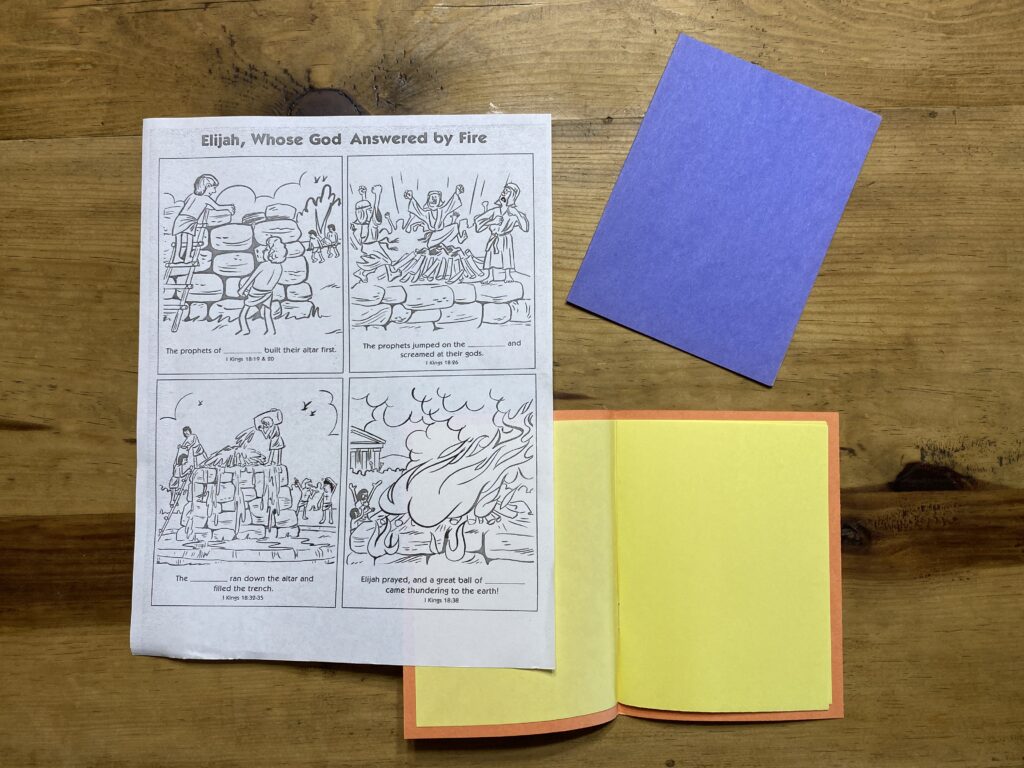
You could cut out the shape of a coat from foam and let the children lace it. This could remind them of Elijah’s mantle that Elijah picked up and kept.
And we know that all things work together for good to them that love God, to them who are the called according to his purpose. —Romans 8:28
Key
Verse Thought: Have you ever had something bad happen to you? According to
this verse, if we are Christians (have Jesus in our heart), and are living
according to God’s Word doing what God wants us to do with our lives,
everything will work out for good — even if it seems like something bad at the
time. In this lesson, we will see this lived out in Elijah’s life. Even when
the king and queen wanted Elijah dead, God provided for him and took care of
him.
Emphasis:
If we will obey God, God will provide for us and take care of us — no
matter what.
Lesson Summary: Now that we have seen the nation of Israel
divide into two kingdoms, Israel
and Judah, we
will begin by studying the nation Israel.
We will continue with Judah
afterward. In our last lesson, we began by learning about the first three kings
of Israel —
Jeroboam, Nadab, and Baasha. Israel
never had a good, or godly, king. In this lesson, we will continue with the
next six kings — including one of the worst kings and his wicked queen.
After seeing four more
wicked kings (Elah, Zimri, Tibni, and Omri), we come to the worst king yet —
King Ahab. After he became king, God sent His prophet, Elijah, to speak to
wicked King Ahab. Elijah told the king that there would be no rain in the land;
and there was a drought for over three years. God provided for Elijah during
the drought and sent him back to King Ahab after three years with a great
challenge. Elijah had all of Israel
to meet on top of Mount Carmel to call for a decision
from the people. Choose who the true God is. After Elijah’s mighty victory, he
ran for his life. We see God had not forgotten him, but He showed himself to
Elijah in a still small voice. He then gave Elijah a helper, Elisha. We will
learn more about him in our next lesson.
We will continue with King
Ahab’s wicked reign as Benhadad, king of Syria,
besieged Israel.
God mightily delivered — twice. However, because King Ahab spared the enemy
king’s life, God would require King Ahab’s life.
We see more of Queen Jezebel’s wickedness as she kills to acquire Naboth’s vineyard for her husband, King Ahab. When Elijah told King Ahab of God’s displeasure about this event, we will see the compassion God had upon King Ahab when he was sorry for sin. When King Ahab joined with the king of Judah, Jehoshaphat, to enter into battle with Syria, a prophet of God told King Ahab that he would die in battle — and he did. King Ahab’s son, Ahaziah, became the next king of Israel. He, too, was a wicked king.
“Think not that I am come to destroy the law, or the prophets: I am not come to destroy, but to fulfil.” Matthew 5:17
When Jesus came, He did not take away the importance of the
Old Testament Law and Prophets; instead, He fulfilled them. This means He
completed them, or made them completely perfect. “Think not that I am come to destroy the law, or the prophets: I am not
come to destroy, but to fulfill” (Matthew 5:17). Fulfill means “to fill out;
complete or made them perfect; to accomplish an end.” Jesus came to complete
(fulfill) the promise God made to Adam and Eve (and all of mankind) in the
garden after they sinned. It was in the garden that God first promised that One
would come and deliver man from his sin. When Jesus came, He did not take away
the importance of the Old Testament Law and Prophets, for He accomplished what
God required of Him. This reveals to us the importance of the Old Testament Law
and Prophets in that Jesus fulfilled the words spoken and preached therein. In
accomplishing all of the requirements found in the Old Testament, Jesus was the
only one qualified, to be the perfect sacrifice to appease the wrath of a just
and righteous God.
Jesus completed everything He came to accomplish. After His
resurrection, Jesus revealed Himself to His disciples. “44. And he said unto
them, These are the words which I spake unto you, while I was yet with
you, that all things must be fulfilled, which were written in the law of Moses,
and in the prophets, and in the psalms, concerning me. 45.
Then opened he their understanding, that they might understand the
scriptures, 46. And said unto them, Thus it is written, and thus it
behoved Christ to suffer, and to rise from the dead the third day: 47. And
that repentance and remission of sins should be preached in his name among all
nations, beginning at Jerusalem. 48. And ye are witnesses of these things”
(Luke 24:44-48).
It is very important to read God’s Word and be in a good
Bible study where you can learn more about Jesus. One important goal each
Christian should have is to know and understand more about the Old Testament
(and the New Testament). The more you learn about the Bible, the more you begin
to understand that it is so much more than just a collection of stories about
people who lived long ago. In reading and studying the Old Testament in the
Bible, you can search and find out why the people who lived in those times
wanted to obey God. It helps you understand how they knew God would one day
send Jesus. You can see what happened to His people when they obeyed God’s
Word, and even what happened when they forgot God’s Word. As you read the New
Testament, you begin to recognize when people began to understand that Jesus
was the One who was to come (the One that was told of in the Old Testament).
These events will be an encouragement to you that God is with those who love
Him, those who seek to please Him, and that He takes care of His people.
In the New Testament, we can read that there was a great plot
to kill Paul because He lived as a Christian, preaching Jesus to the lost
(those who did not believe in Jesus). Paul, the apostle, used this in his
defense before Festus: “But this I
confess unto thee, that after the way which they call heresy, so worship I the
God of my fathers, believing all things which are written in the law and in the
prophets” (Acts 24:14).
He believed all things written in the Law and Prophets
that told of Jesus.
And Jesus knew their thoughts, and said unto them, Every kingdom divided against itself is brought to desolation … —Matthew 12:25a
Key Verse Thought: Have you ever heard the phrase “there is
strength in numbers?” Think of the following instances to help in the
understanding of this concept: Work is completed faster with more workers; a
choir has a stronger voice with more choir members singing; the more papers you
have stacked together, the harder it is to tear them in two; it is harder to
break a bundle of sticks bound together than just one stick, etc. What happens
when more than one person tries to explain rules to a game (especially if they
list different rules)? Unless everyone agrees, or works together, it is almost
impossible to play the game or even to accomplish a task. Also remember the
following: “And if one
prevail against him, two shall withstand him; and a threefold
cord is not quickly broken” (Ecclesiastes 4:12).
In this lesson we will see what happened that caused the nation of Israel
to become divided. In our key verse for
this lesson, the word desolation
means “be laid waste; be made desolate (deprived of inhabitants; neglected;
destroyed).”
Emphasis: We must learn from history. Israel
rejected God and chose idol worship bringing division and destruction to the
nation. The same division and destruction will occur in our lives if we reject
God.
Lesson
Summary: Now that we have completed the Personal Books (mostly written by
David and Solomon), we will continue with the History Books. If you remember,
the people rejected God as their king and wanted a man like all of the other
nations to rule over them. God gave the people a man to become their king, just
like they wanted. We learned about the first three kings: Saul, David, and
Solomon. Saul disobeyed God, and the kingdom was removed from him and his
family. David was known as a man after God’s own heart, and God promised him
the kingdom would never be removed from his family. Solomon, David’s son,
became the next king, but he ended up allowing his heart to be turned from God
to idols. God promised to divide the kingdom because of this great sin, but
because of God’s promise to David, two tribes would be left to his family.
In this lesson, we will learn that Rehoboam,
Solomon’s only son, was a very foolish king. God left two tribes for him to
rule. They became known as Judah (also known as the Southern Kingdom). God gave
the other ten tribes to Jeroboam, and they became known as Israel
(the Northern Kingdom). When Jeroboam became king over
the Northern Kingdom, Israel,
he did not allow the people return to Jerusalem
to worship God. He was afraid that he would lose his kingdom, and the divided
kingdom would reunite as one. So he set up two places of worship, Dan and Bethel,
with golden calves in each city for the people to worship. When Jeroboam was
warned by a prophet of God while offering at the altar, Jeroboam rejected his
words. King Jeroboam’s hand was withered and then restored. Later, when
confronted with his wickedness, he rejected God’s prophet, and God rejected
Jeroboam telling him the kingdom would be removed from him and his family. And
it came to pass – just as God said.
Israel and Judah warred against each other continually. After this lesson, we will primarily continue our study with the Northern Kingdom (Israel). Afterward we will learn of the Southern Kingdom (Judah). To help keep the kings straight and find out a verse listed where they became king, refer often to the chart “The Kings and their Prophets.”