Tag: Quarter Four

  • Lesson 5: Ezra 1-5 and Haggai Zerubbabel Begins Rebuilding the Temple

    Key Verse

    And let us not be weary in well doing: for in due season we shall reap, if we faint not.

    —Galatians 6:9

    Key Verse Thought: Read the Key Verse. Understand that sometimes we get tired of doing what God wants us to do, but we are never to quit! God has promised to honor our work – if we do not quit. In this lesson, we will see God’s people begin the rebuilding of the Temple in Jerusalem.

    Emphasis: Christians should never become tired of doing what God has for us – even when the adversaries try to stop us. We are to complete what God has for us to do, knowing He will honor that work.

    Lesson Summary: As we begin this lesson, we remember that the people were carried captive in three definite movements. We will discover that the people were returned back to their homeland in three definite movements. We will learn of the first movement, led by Zerubbabel, today.

    Cyrus was now ruler in the land of captivity (remember the Babylonians were defeated by the Medes and Persians). We will read that God stirred Cyrus’ heart to send people home (to Jerusalem) to rebuild the house of the Lord. Not only that, but he sent many treasures back to Jerusalem with the people – including the vessels that belonged in the house of the Lord. The first group to return to Jerusalem was led by Zerubbabel, a descendant of David.

    Once they reached Jerusalem, Zerubbabel remained a leader. Jeshua (Joshua) was the high priest. These two men led the people first to rebuild the altar of the Lord. Then they laid the foundation of the Temple of the Lord. That was when the troubles began. Adversaries arose, and Zerubbabel understood they were not for God’s people, but against them. Zerubbabel would not allow them to help in the building of God’s house. These adversaries caused trouble for years, stopping the building of the Temple.

    God then sent His prophet, Haggai, to encourage the people to build the house of the Lord. First, he scolded them for living in their nice houses while the Temple of the Lord was not completed. He reminded the people that God was to come first. “7. Thus saith the LORD of hosts; Consider your ways. 8. Go up to the mountain, and bring wood, and build the house; and I will take pleasure in it, and I will be glorified, saith the LORD” (Haggai 1:7-8). Haggai then encouraged the leaders to complete the Temple. Zerubbabel and Joshua stepped up and began work on the Temple again – and God kept the enemy from stopping them.

    Y2Q4 – Lesson 5 Questions

    Y2Q4 – Lesson 5 Children’s Worksheets

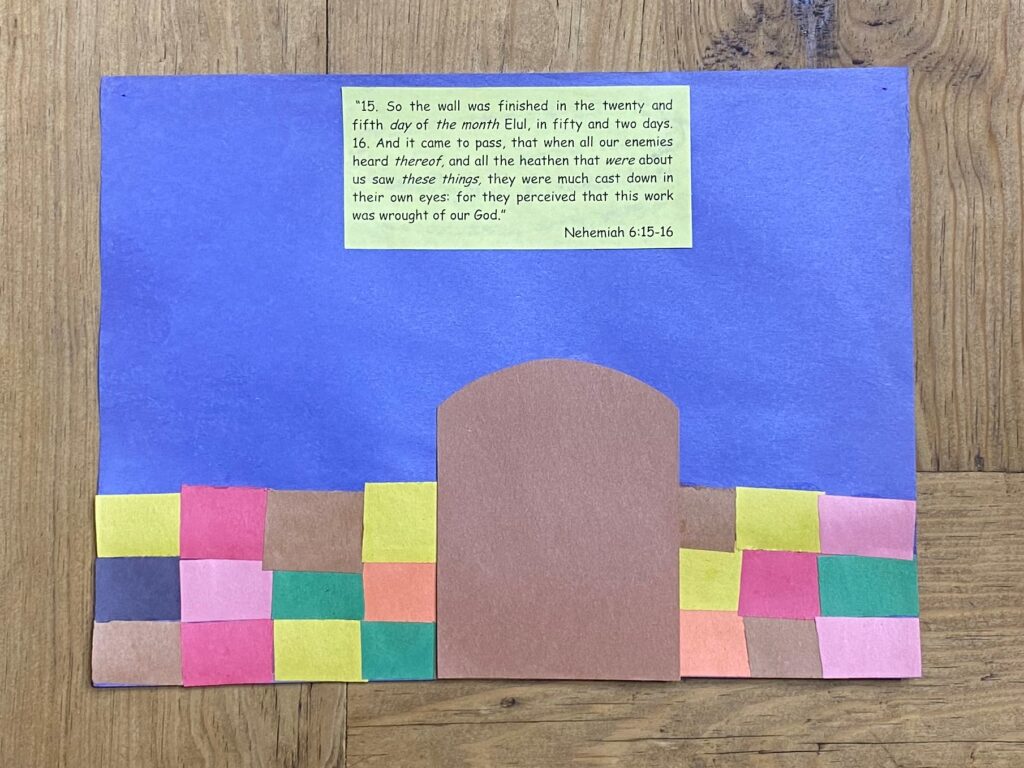
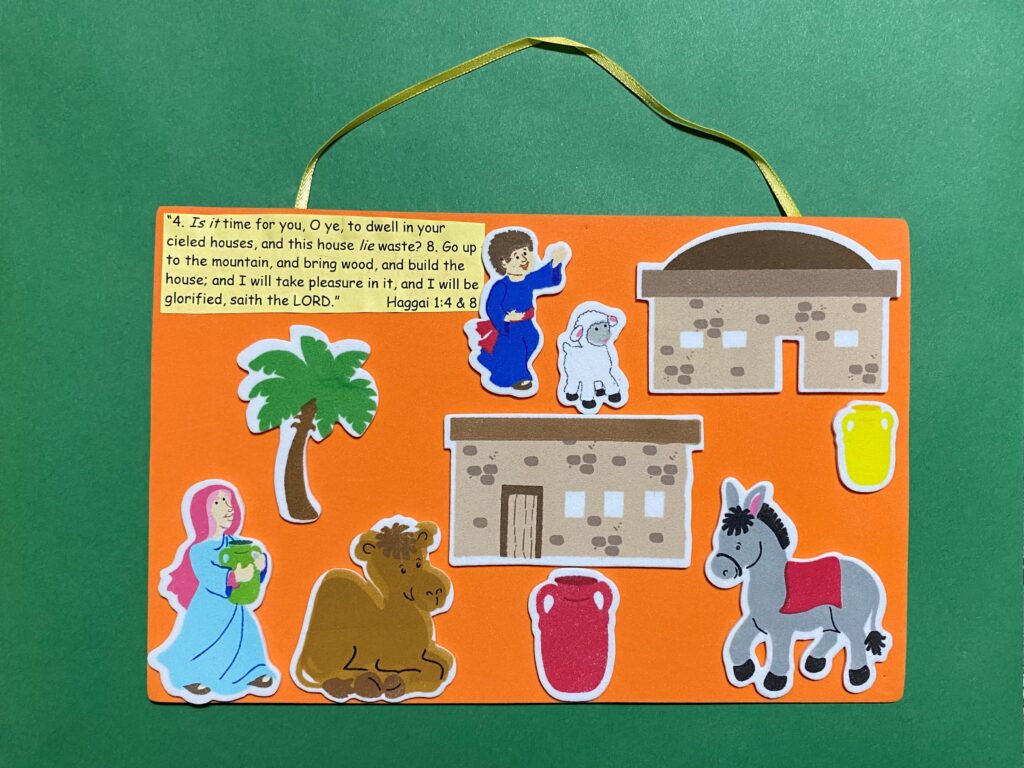
    If you are teaching this to children, the following is a craft idea to go with this lesson to help them remember it:

    We made scenes to remind us the importance of not quitting or be content, but to finish what God has us to do – much like Haggai encouraged them to finish the House of the Lord.

  • Lesson 4: Daniel 5-12: Daniel, God’s Man

    Key Verse

    For the eyes of the Lord are over the righteous, and his ears are open unto their prayers: but the face of the Lord is against them that do evil. 

    —1 Peter 3:12

    Key Verse Thought: Read the Key Verse. According to our key verse, we can understand that God sees and hears His people. When enemies try to do evil against God’s people, He knows and takes care of the problem.

    Emphasis: We are to learn to consistently, faithfully, walk with God and read His Word – just as Daniel did.

    Lesson Summary: In our last lesson, we learned about Daniel and his three friends who were carried captive during the first siege of Jerusalem. We that found they remained faithful to God in the enemy land. In this lesson, we will continue with Daniel’s life.

    A new king reigned in Babylon. His name was Belshazzar, and he was King Nebuchadnezzar’s grandson. We read today of a time he drank wine before his thousands. When he called for the vessels from the house of the Lord to be brought to him and led them to drink with them, toasting many false idols, a hand appeared and wrote upon the wall. When no one understood the meaning, Daniel was called. After reminding King Belshazzar of his grandfather, King Nebuchadnezzar, and his acknowledgment of God, Daniel rebuked King Belshazzar for not acknowledging God. The handwriting declared King Belshazzar would lose his kingdom that night – and he did. With that came the demise of the Babylonian reign. Next, the Medo-Persian kingdom became predominant. 

     King Darius, the new king, placed Daniel as the head of his one hundred twenty presidents, and they hated Daniel for it. It was then that they began plotting to destroy him. When Daniel continued to pray to God three times daily, breaking the new law of the land, he was thrown into the den of lions. Nevertheless, through all of this, King Darius recognized God’s hand in Daniel’s life. The wicked men who tricked King Darius into signing that bad law were thrown (with their families) into the lions’ den where they all died.

    Although some do not believe Daniel was a real man (because of the accuracy of the events recorded in the book of Daniel – long before they happened), we read that Ezekiel knew of Daniel and Jesus quoted Daniel. 

    Daniel not only wrote many of God’s Words (recorded in the Bible), but he read God’s Words recorded by other men of God. We will find what he learned while reading the book of Jeremiah.

    Additional note:  Many of the things portrayed in the book of Daniel are also found in the book of Revelation. Things from every chapter in Daniel are referred to in the book of Revelation, and most of the chapters in Revelation have references to the book of Daniel. Therefore, in order to understand Revelation, it is important to know the book of Daniel. Because this is not an exhaustive study of Daniel but an overview, we will not take time to compare the two books in this lesson.

    Y2Q4 – Lesson 4 Questions

    Y2Q4 – Lesson 4 Children’s Worksheets

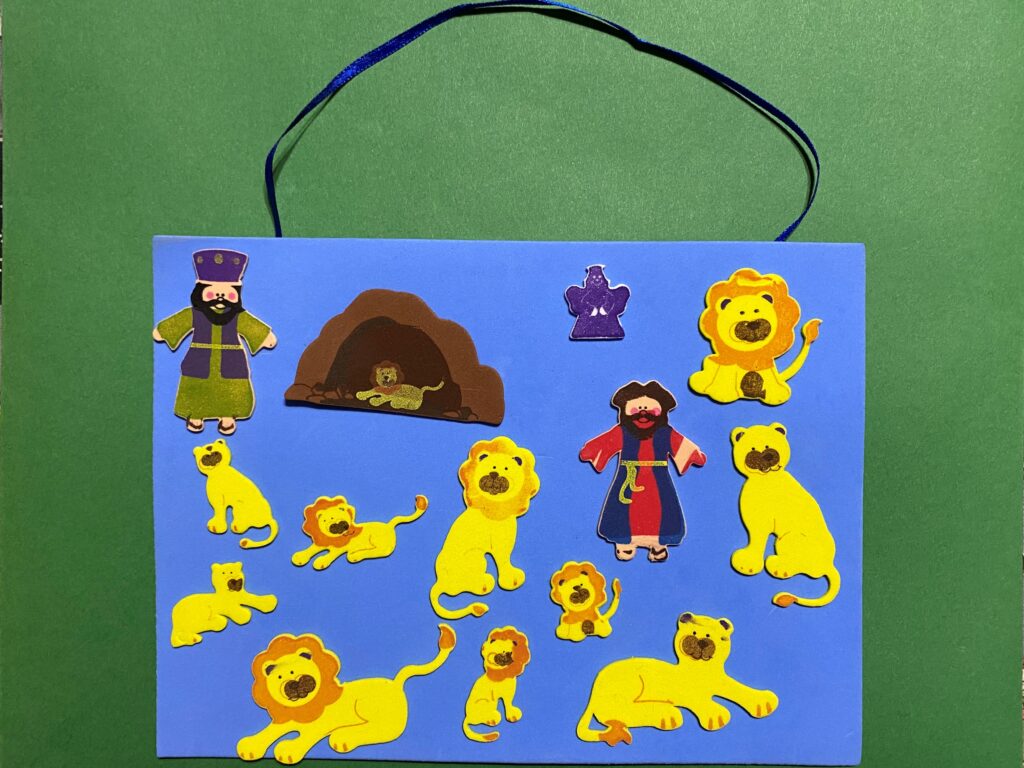
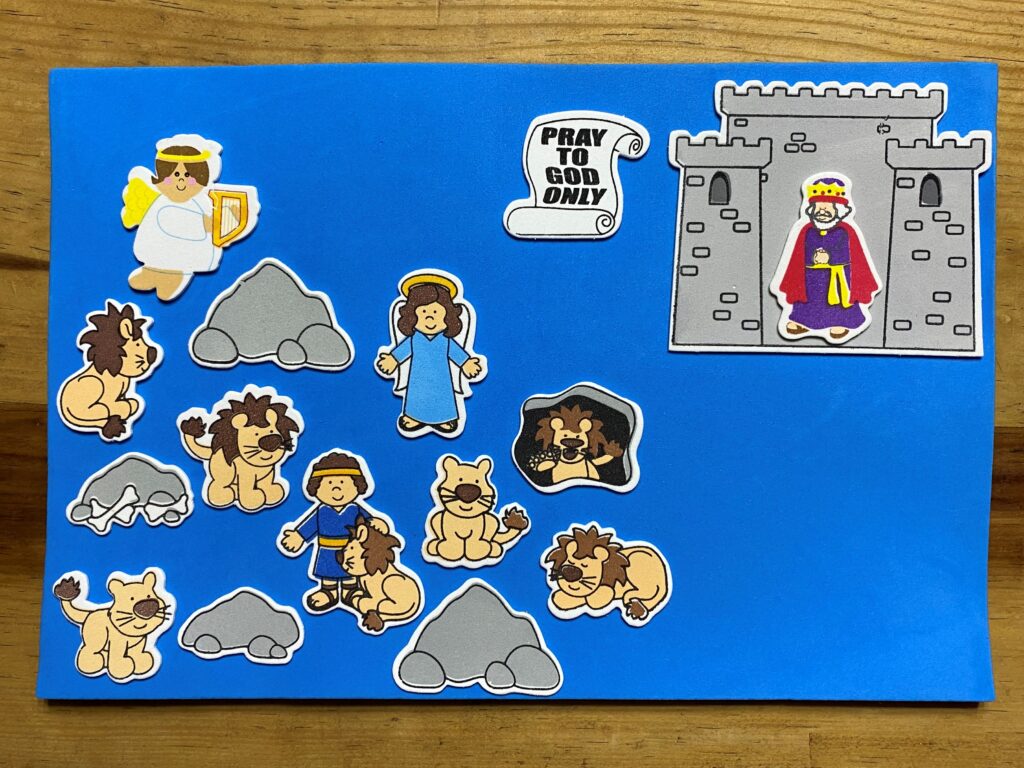
    If you are teaching children, the following is a craft idea to help them remember Daniel.

    We made Daniel in the Lion’s Den scenes with stickers.

  • Lesson 2: Ezekiel 33-48 Judah’s Future

    Key Verse

    Therefore, my beloved brethren, be ye stedfast, unmoveable, always abounding in the work of the Lord, forasmuch as ye know that your labour is not in vain in the Lord.

    —1 Corinthians 15:58

    Key Verse Thought: Read the Key Verse. We are to understand what it means to be “stedfast, unmoveable, always abounding in the work of the Lord.” That means: not changing or moving, but being more abundant or distinguished than somebody else in reference to doing something. We are to try to be the best Christian living for Jesus than anyone else around us – for we know that even though it may be very difficult (labour), we also know that our life will not be fruitless in God’s eyes.

    Emphasis: We are to remain true to the task God places before us, no matter how difficult it may seem – even if people ignore us and reject God’s Word (just as they did to Ezekiel), when we tell others about Jesus. 

    Lesson Summary: God called Ezekiel again, to be a watchman to Israel. He was to continue warning the people – especially the children of God’s people. The children would be the ones who would eventually return to Jerusalem. God warned Ezekiel that he would be accountable to God if he was not faithful to speak the Words God gave him to speak. 

    While Ezekiel was warning God’s people, a messenger came with the news that Jerusalem had been smitten (defeated; destroyed). Ezekiel proceeded to remind them why Jerusalem had been destroyed. Although the people listened to the message, they did not adhere to the teachings.

    Ezekiel had to remind the people why they lost their homeland and their beloved city, Jerusalem. It was because they forsook God and worshiped idols instead. Nevertheless, after this reminder, they were encouraged with the words that God would one day restore their homeland to them. After these words, God gave Ezekiel an unusual visual to help him understand what God would do for His people one day. God took Ezekiel to a valley full of dry bones and told him to preach the Word of the Lord to them. When he did, the bones were rejoined and skin covered them again. After God breathed life into them, those dead bones lived. It was a picture of the dead, desolate nation Israel would be when God would one day restore them. 

    God would join the divided kingdom as one nation with one king, they would reject idolatry once and for all and God would be their God, and God then gave the promise of Jesus.  Jesus would be the king over God’s people, the one shepherd, and he would be their prince – forever.

    Y2Q4 – Lesson 2 Questions

    Y2Q4 – Lesson 2 Children’s Worksheets

    If you are teaching this lesson to younger children, the following is a craft idea to help them remember this lesson:

    We made a book with the pictures of the different stages of the events that took place when Ezekiel preached in the Valley of the Dry Bones.
  • Lesson 1: Ezekiel 1-32 Judah’s Fall

    Key Verse

    Obey them that have the rule over you, and submit yourselves: for they watch for your souls, as they that must give account, that they may do it with joy, and not with grief: for that is unprofitable for you.

    —Hebrews 13:17

    Key Verse Thought: Read the Key Verse. Think for a minute. Is it ever hard to obey someone who is in authority over you? Consider the authority in the written Word of God and those who teach the doctrines therein. Even when it may be difficult, we are called to not only obey, but also choose to do it correctly. Consider how you treat one who teaches you (and may occasionally correct or admonish you). Do not make their task more difficult, for they must give an accounting to God for how they teach you, and they want it to be a joyful time. If you respond incorrectly, you may just miss the blessing intended for your life.

    Emphasis: We must first have a heart of flesh, so God’s Word can be written therein. Then we must be a watchman, telling all of the world about Jesus, so they can know God as the God.

    Lesson Summary: Weeks of Bible study time could be spent just on the book of Ezekiel. However, because we are not doing an exhaustive study, but an overview, we will take two lessons to study highlights of the book of Ezekiel. Remember that Jeremiah witnessed the captivity of Judah by Babylon and the destruction of Jerusalem. The book of Lamentations, written by Jeremiah, is a poem revealing the horrors of seeing the city of Jerusalem and the temple of God destroyed after a terrible siege against the city. Jeremiah and Ezekiel both lived during the demise of Israel.

    Ezekiel was carried captive from Jerusalem during the second invasion of Babylon by King Nebuchadnezzar. Once in Babylon, God came to Ezekiel in a heavenly vision and called him to be a watchman for God to the house of Israel. God gave Ezekiel the words that needed to be spoken to His people. The people of Judah had to understand that they were being disciplined for their sin. God often called Ezekiel “the son of man.”    

    After God showed Ezekiel the wickedness that had permeated God’s Temple, Ezekiel witnessed God’s Spirit depart from the Temple in Jerusalem, and finally from this earth.

    God was chastising His people by using their enemy, Babylon. It was because of the many transgressions of God’s people. But most importantly, God wanted His people to know that He is the Lord (this is expressed around 70 times in Ezekiel). Ezekiel was to be sure to let God’s people know that He had not forsaken them, but that He had future plans for them.

     As many other prophets before, Ezekiel was to call the people to repentance. There were many signs that God had Ezekiel use to gain the people’s attention, and to reinforce the message God had for His people. For lack of time, we will not look at these. (Some of the signs of Ezekiel: a tile, filthy food, a razor, a pot, a fire, lay on left/right, prepare his clothes to move, smite hands together, not to mourn his wife’s death, etc.)

    It is in the book of Ezekiel where we also understand that God judges each individual. God does not save the child because of the father, or the father because of the child. Each person is accountable unto God for his or her actions in his or her own life – whether in righteousness or in iniquity. God wants each individual to turn from his or her sin, and only then will he or she live.

    Y3Q4 – Lesson 1 Questions

    Y3Q4 – Lesson 1 Children’s Worksheets

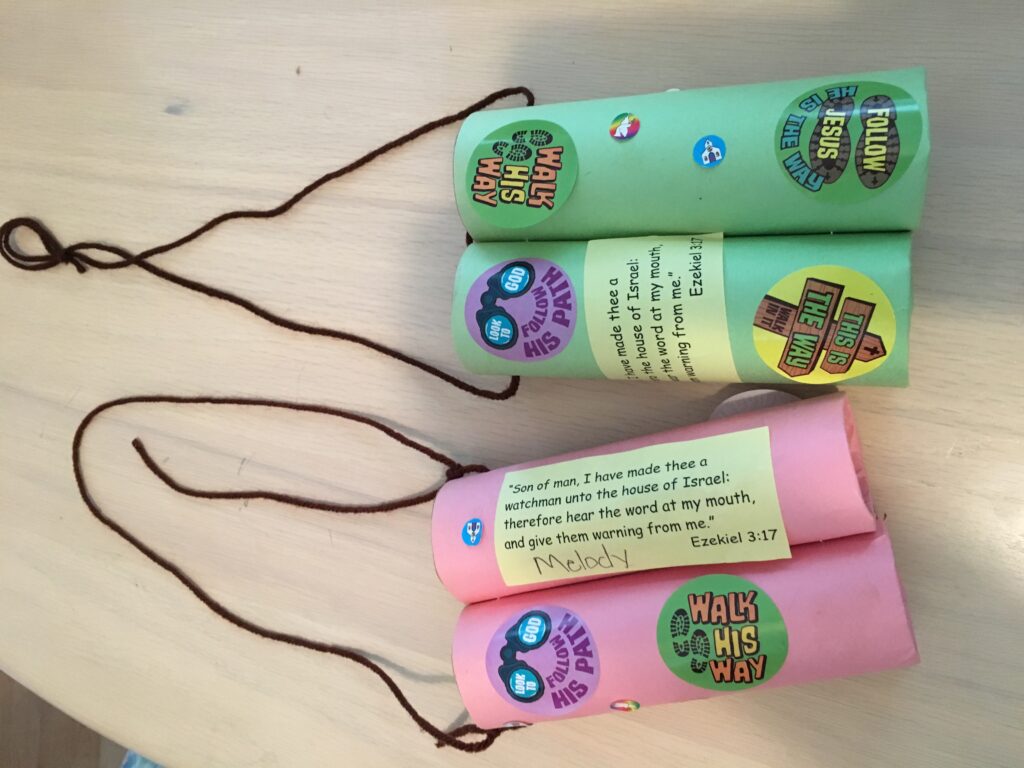
    If you are teaching this to younger children, the following is a craft idea to help them remember this lesson:

    We made binoculars adding stickers and the verse Ezekiel 3:17 to help us remember the importance of being a Watchman (like Ezekiel) who warns people with the Word of God.