Tag: Jeremiah

  • Have Thine own way, Lord!

    But in a great house there are not only vessels of gold and of silver, but also of wood and of earth; and some to honour, and some to dishonour.”

    2 Timothy 2:20

    God had sent Jeremiah to watch a potter work a piece of clay, making it into a vessel (see Jeremiah 18:1-4). Jeremiah recognized that God is the Potter and we are the clay. The Potter took the clay and fashioned it into a vessel to be used. We understand this to be a picture of God dealing with individual people. Our choice: to receive or reject God’s work.

    God deals with patience and mercy with all vessels. Notice that He deals with them – not as lifeless clay, but as creatures with a free will. Why? “Who will have all men to be saved, and to come unto the knowledge of the truth” (1 Timothy 2:4). God has unlimited power over the clay. Yet, He allows freedom; God will yield to our choice. He gives ample opportunity to reveal any inclination one might have of obeying God. We gain some insight into this in Romans. “20. Nay but, O man, who art thou that repliest against God? Shall the thing formed say to him that formed it, Why hast thou made me thus? 21. Hath not the potter power over the clay, of the same lump to make one vessel unto honour, and another unto dishonour?” (Romans 9:20-21). Honor means “by analogy esteem (especially of the highest degree), or the dignity itself.Dishonor means “it refers to dishonor, disgrace.” Take note that the clay is in His hand and under His control, yet while working with the individual, God gives ample opportunity to reveal any inclination that one might have of obeying God. Nevertheless, there are those who challenge the Potter (God). Some clay (vessel) that God is shaping will not take His designing. But, God is long-suffering. “The Lord is not slack concerning his promise, as some men count slackness; but is longsuffering to us-ward, not willing that any should perish, but that all should come to repentance” (2 Peter 3:9). Some rebel against God’s plan, and that one continues on under the judgment of the God it questions. God hates sin and it must be dealt with, but His mercy goes out to the vessel involved. If we insist upon destroying ourselves, He will allow us to do that. If we insist upon not being repentant, and instead choose to be disobedient and/or rebellious, He will give us our desire – at least the fruits of that choice. Yet, God patiently waits for His people to allow Him to shape and mold them into what He wants them to be. Keep in mind: The Potter has an intended purpose for us. He has a goal. We may frustrate that goal. Remember that some become vessels of honor, some vessels of dishonor.

    Understanding there are vessels of honor and dishonor, read the following verses: “But in a great house there are not only vessels of gold and of silver, but also of wood and of earth; and some to honour, and some to dishonour” (2 Timothy 2:20).Vessels of gold and silver are vessels of honor. Read a description of such a one from Psalms. “23. The steps of a good man are ordered by the LORD: and he delighteth in his way. 24. Though he fall, he shall not be utterly cast down: for the LORD upholdeth him with his hand” (Psalm 37:23-24). Vessels of wood and earth are vessels of dishonor. One can recognize a vessel of dishonor in Isaiah. “Woe unto him that striveth with his Maker! Let the potsherd strive with the potsherds of the earth. Shall the clay say to him that fashioneth it, What makest thou? or thy work, He hath no hands?” (Isaiah 45:9). When we refuse God’s will, we are injuring ourselves, or depriving ourselves of the joy and satisfaction of being where God wants us to be, fulfilling His purpose for our lives . Remember: “For we are his workmanship, created in Christ Jesus unto good works, which God hath before ordained that we should walk in them” (Ephesians 2:10). God has a plan. It is our job, as Christians, to submit to Him and walk in it (see also 2 Timothy 2:21). The key to what kind of a vessel we will be is determined by how we respond to the Potter’s touch and our obedience to His Word. “23. And whatsoever ye do, do it heartily, as to the Lord, and not unto men; 24. Knowing that of the Lord ye shall receive the reward of the inheritance: for ye serve the Lord Christ. 25. But he that doeth wrong shall receive for the wrong which he hath done: and there is no respect of persons” (Colossians 3:23-25). There are many who refuse to submit fully to God and His Word. The defects are not in the Potter but in the clay.

    The following song is a great reminder of this lesson.

    Have Thine own way, Lord!

    Author: Adelaide A. Pollard (1906)

    1. Have Thine own way, Lord! Have Thine own way!
    Thou art the Potter, I am the clay.
    Mold me and make me After Thy will,
    While I am waiting, Yielded and still.

    2.Have Thine own way, Lord! Have Thine own way!
    Search me and try me, Master today!
    Whiter than snow, Lord, Wash me just now,
    As in Thy presence Humbly I bow.

    3.Have Thine own way, Lord! Have Thine own way!
    Wounded and weary, Help me I pray!
    Power, all power, Surely is Thine!
    Touch me and heal me, Saviour divine!

    4.Have Thine own way, Lord! Have Thine own way!
    Hold o’er my being, Absolute sway!
    Fill with Thy Spirit, Till all shall see
    Christ only, always, Living in me!

    Are you where God wants you to be, submitting to the Potter’s hand, fulfilling what He has planned for your life?
  • The Potter and the Clay

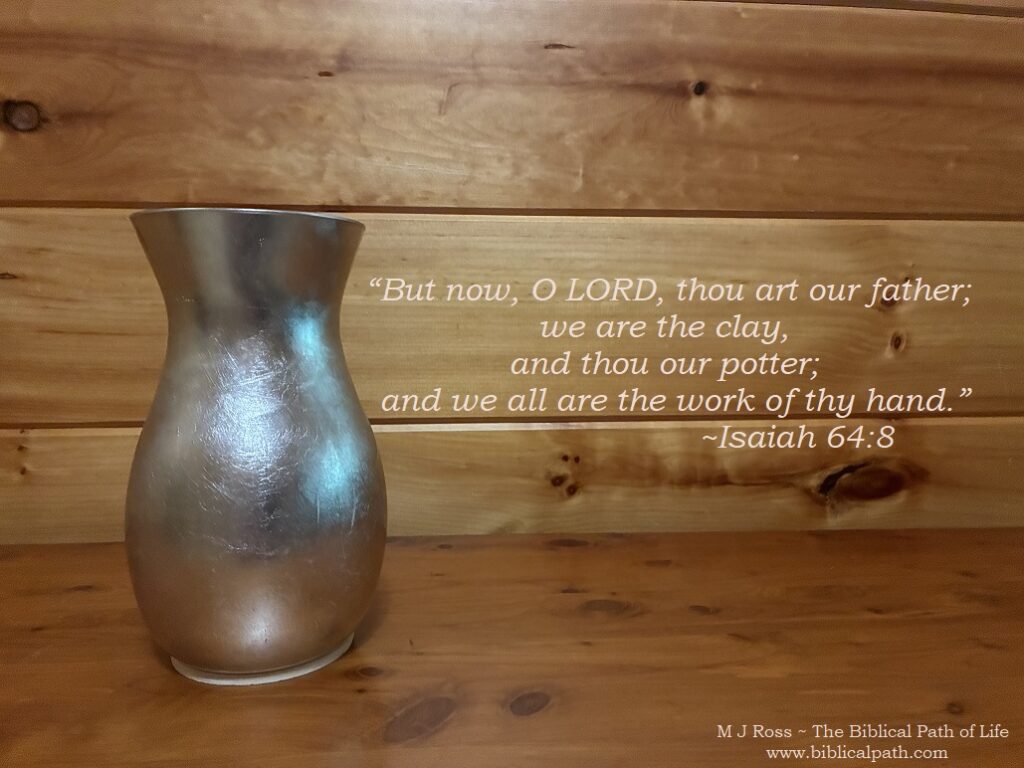
    But now, O LORD, thou art our father; we are the clay, and thou our potter; and we all are the work of thy hand.”

    Isaiah 64:8

    Oftentimes in the Bible, God uses objects to teach lessons. Sometimes the picture is very clear, and sometimes one must dwell on the lesson to understand it. The prophets were often taught things in this manner. Jeremiah was taught by many object lessons that the Lord showed him. One such instance is recorded in Jeremiah chapter eighteen. However, what Jeremiah saw and understood has been recorded in God’s Word to teach us even today.

    1. The word which came to Jeremiah from the LORD, saying, 2. Arise, and go down to the potter’s house, and there I will cause thee to hear my words” (Jeremiah 18:1-2). God had something important for Jeremiah to see. There was a message Jeremiah needed to understand. Jeremiah obeyed God and went to the potter’s house. “3. Then I went down to the potter’s house, and, behold, he wrought a work on the wheels.” (Jeremiah 18:3). If you have ever watched a potter work with clay, you may have a picture in your mind. The potter takes the lump of clay, places it on the center of the wheel, and begins to spin it. The potter then uses water on his hands to keep the clay soft and pliable as he shapes that lump of clay into a beautiful vessel. Jeremiah watched the potter work. “And the vessel that he made of clay was marred in the hand of the potter: so he made it again another vessel, as seemed good to the potter to make it.” (Jeremiah 18:4).

    • Potter means “to form, to fashion, to devise, to frame; to produce, to create; to be formed or fashioned… The word implies initiation as well as structuring… squeezing or molding…
    • Wrought means “to work, labor, toil; to make, create, construct… deals with refinement; the emphasis was on fashioning the created objects.
    • Marred means “to decay; to mar; to destroy, devastate.
    • Good means “The Hebrew idiom ‘to be right in the eyes of (someone)’ means to have that person’s approval. Examples: Judges 14:3;1 Samuel 18:26; 2 Chronicles 30:4… Jeremiah 18:4.

    As Jeremiah watched the potter work, the clay was marred. It was destroyed. The potter had to begin anew to make a piece of pottery from that clay. As he worked that clay, the potter made another vessel that pleased him, meeting his approval. While watching the Potter with the clay, Jeremiah recognized the Spiritual significance of what he was seeing. Jeremiah understood the “sermon” in the marred vessel.

    I wonder if what Isaiah had taught came to Jeremiah’s mind as he watched this process. “But now, O LORD, thou art our father; we are the clay, and thou our potter; and we all are the work of thy hand” (Isaiah 64:8). Remembering that God is the Potter, and we are the clay might have brought another thought into Jeremiah’s heart and mind. “4. Then the word of the LORD came unto me, saying, 5. Before I formed thee in the belly I knew thee; and before thou camest forth out of the womb I sanctified thee, and I ordained thee a prophet unto the nations” (Jeremiah 1:4-5). God had told Jeremiah that He had formed Jeremiah in his mother’s womb before he was born. The word here for formed is the same Hebrew word for Potter. Not only had God formed Jeremiah, but He had a plan and purpose for Jeremiah’s life.

    God explained what Jeremiah was seeing, so he would have a message to deliver to God’s people. “5. Then the word of the LORD came to me, saying, 6. O house of Israel, cannot I do with you as this potter? saith the LORD. Behold, as the clay is in the potter’s hand, so are ye in mine hand, O house of Israel” (Jeremiah 18:5-6). Although these verses in Jeremiah eighteen deal with Israel, we can understand that God is the Potter, and people are the clay. God gave a parable to Jeremiah about God and Israel. Yet in that parable is a great lesson for each of us to learn. God wants to make and mold us into a vessel that can be used by and for Him.

    For Christians today, it would be good to remember that God not only created each of us, but He has a plan and a purpose for each life. “8. For by grace are ye saved through faith; and that not of yourselves: it is the gift of God: 9. Not of works, lest any man should boast. 10. For we are his workmanship, created in Christ Jesus unto good works, which God hath before ordained that we should walk in them” (Ephesians 2:8-10). We did nothing to earn that salvation from God, however, He does have a plan and purpose for our lives that He expects us to walk in. Much like Jeremiah.

    Have you recognized the plan and purpose God has for you life, and are you walking it it?

  • Words of Encouragement

    For I know the thoughts that I think toward you, saith the LORD, thoughts of peace, and not of evil, to give you an expected end.”

    Jeremiah 29:11

    Jeremiah always delivered the messages God gave him faithfully, even when it was difficult for him. He chose to obey God, calling Judah to repent and return to God. Jeremiah had little, if any, hope of God’s people truly repenting and returning to God, yet he faithfully obeyed. What courage! As you read the book of Jeremiah, you will understand that the people did not repent, so God allowed the enemy to take them captive and destroy Jerusalem. Jeremiah witnessed the destruction of his beloved city, and his people carried captive to a foreign land.

    God gave Jeremiah a message to send to the people who were taken captive before God allowed the Babylonians to besiege Jerusalem. They were words of encouragement that are read by many even today.

    Read some of the letter that Jeremiah sent to the Jews of the first captivity. “Now these are the words of the letter that Jeremiah the prophet sent from Jerusalem unto the residue of the elders which were carried away captives, and to the priests, and to the prophets, and to all the people whom Nebuchadnezzar had carried away captive from Jerusalem to Babylon” (Jeremiah 29:1). We are to understand that this is the first carrying away of captives by Babylon (see Jeremiah 29:2). Read the message. “4. Thus saith the LORD of hosts, the God of Israel, unto all that are carried away captives, whom I have caused to be carried away from Jerusalem unto Babylon; 5. Build ye houses, and dwell in them; and plant gardens, and eat the fruit of them; 6. Take ye wives, and beget sons and daughters; and take wives for your sons, and give your daughters to husbands, that they may bear sons and daughters; that ye may be increased there, and not diminished. 7. And seek the peace of the city whither I have caused you to be carried away captives, and pray unto the LORD for it: for in the peace thereof shall ye have peace” (Jeremiah 29:4-7). First, he wanted them to understand they would be in Babylon for a while, so they needed to take up residence. They were to build houses, plant gardens, get married, and have families. Most importantly, they were to pray unto the Lord. They were not to listen to the false prophets who were speaking among them. “8. For thus saith the LORD of hosts, the God of Israel; Let not your prophets and your diviners, that be in the midst of you, deceive you, neither hearken to your dreams which ye cause to be dreamed. 9. For they prophesy falsely unto you in my name: I have not sent them, saith the LORD” (Jeremiah 29:8-9). The Israelites were to understand that they would be there for seventy years. After that seventy years, their discipline would end, and God would allow them to return back to the land God had promised them. “10. For thus saith the LORD, That after seventy years be accomplished at Babylon I will visit you, and perform my good word toward you, in causing you to return to this place. 11. For I know the thoughts that I think toward you, saith the LORD, thoughts of peace, and not of evil, to give you an expected end. 12. Then shall ye call upon me, and ye shall go and pray unto me, and I will hearken unto you. 13. And ye shall seek me, and find me, when ye shall search for me with all your heart. 14. And I will be found of you, saith the LORD: and I will turn away your captivity, and I will gather you from all the nations, and from all the places whither I have driven you, saith the LORD; and I will bring you again into the place whence I caused you to be carried away captive” (Jeremiah 29:10-14). God loved His people and did not want them to have troubles, but His people needed to learn that they had to seek God with all of their hearts – and then they would find him. God had a plan and a reason for that captivity. During their time in Babylon, God’s people finally learned to seek the Lord.

    The following verse is quoted often today: “For I know the thoughts that I think toward you, saith the LORD, thoughts of peace, and not of evil, to give you an expected end” (Jeremiah 29:11). This is a very encouraging verse. However, I would like you to consider something. In order for God’s people to come to this place in their relationship with God, they had to be taken captive from their homes because they had refused to repent of their sin and turn to God. It was only in their captivity, when they finally repented, that God was able to give them these encouraging words. “12. Take heed, brethren, lest there be in any of you an evil heart of unbelief, in departing from the living God. 13. But exhort one another daily, while it is called To day; lest any of you be hardened through the deceitfulness of sin” (Hebrews 3:12-13). It would be good for us to repent and turn from sin much sooner than the Israelites did. It would prevent much heartache. “10. For with the heart man believeth unto righteousness; and with the mouth confession is made unto salvation. 11. For the scripture saith, Whosoever believeth on him shall not be ashamed. 12. For there is no difference between the Jew and the Greek: for the same Lord over all is rich unto all that call upon him. 13. For whosoever shall call upon the name of the Lord shall be saved” (Romans 10:10-13). Time is short. Repent and believe today!

    Have you chosen the things of this world instead of repenting and trusting in Jesus?

    Trust in Jesus: How to be saved

  • Jeremiah’s Help in a Time of Need

    For God is not unrighteous to forget your work and labour of love, which ye have shewed toward his name, in that ye have ministered to the saints, and do minister.”

    Hebrews 6:10

    Jeremiah faithfully proclaimed God’s Words to the kings and the people, warning them of the coming destruction and captivity, if they did not repent and return to God. When the people failed to repent, God allowed the Babylonians to besiege Jerusalem. Jeremiah witnessed the captivity of Judah by Babylon and the destruction of Jerusalem, the city where God had chosen to place His name. Even through all of this, Jeremiah continually shared the Word of the Lord with the people. We should recognize that at times he suffered and was rejected. This helps us understand why Jeremiah is known as the “Weeping Prophet”. Often, his life was in danger. However, we never read that Jeremiah quit God.

    Remember a few of the times Jeremiah was unjustly imprisoned, and God’s protection, allowing him to continue delivering God’s Words to the people and the kings.

    • Jeremiah was put in the stocks: (Jeremiah 20:1-2).
    • Jeremiah was shut up in the court of the prison in the king’s house: (Jeremiah 32:2-3).
    • Jeremiah was falsely accused, they smote him, and put him in prison: (Jeremiah 37:13-15).
    • He was in prison when Jerusalem was taken by Babylon (see Jeremiah 38:28).

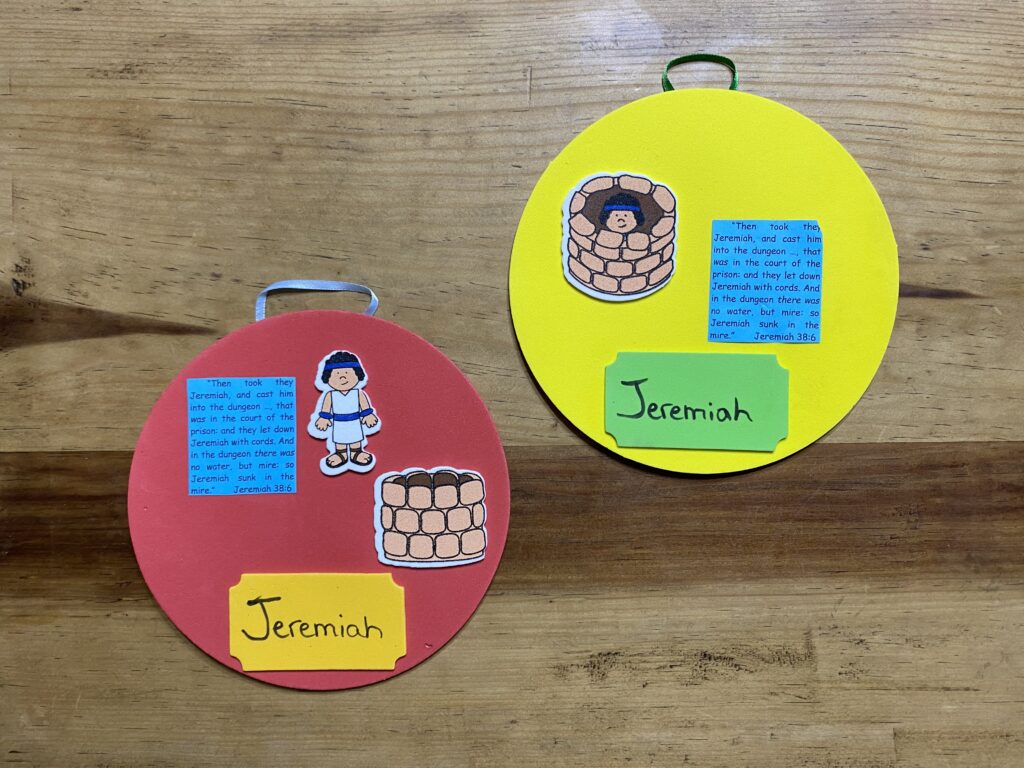
    Probably the most familiar time we remember is when Jeremiah was lowered into a dungeon (probably an old cistern) where he sunk in the mire. Read some of when Jeremiah was in the dungeon: “1. Then Shephatiah … heard the words that Jeremiah had spoken unto all the people, saying, 2. Thus saith the LORD, He that remaineth in this city shall die by the sword, by the famine, and by the pestilence: but he that goeth forth to the Chaldeans shall live; for he shall have his life for a prey, and shall live … 4. Therefore the princes said unto the king, We beseech thee, let this man be put to death … 5. Then Zedekiah the king said, Behold, he is in your hand … 6. Then took they Jeremiah, and cast him into the dungeon … that was in the court of the prison: and they let down Jeremiah with cords. And in the dungeon there was no water, but mire: so Jeremiah sunk in the mire” (Jeremiah 38:1-6). Jeremiah was put into a “dungeon” (probably an empty cistern) where there was no water.

    7. Now when Ebedmelech the Ethiopian, one of the eunuchs which was in the king’s house, heard that they had put Jeremiah in the dungeon… 8. Ebedmelech went forth out of the king’s house, and spake to the king, saying, 9. My lord the king, these men have done evil in all that they have done to Jeremiah the prophet, whom they have cast into the dungeon; and he is like to die for hunger in the place where he is: for there is no more bread in the city” (Jeremiah 38:7-9). This man, Ebedmelech the Ethiopian, had compassion for Jeremiah. He wanted to spare Jeremiah’s life.

    10. Then the king commanded Ebedmelech the Ethiopian, saying, Take from hence thirty men with thee, and take up Jeremiah the prophet out of the dungeon, before he die. 11. So Ebedmelech took the men with him… and took thence old cast clouts and old rotten rags, and let them down by cords into the dungeon to Jeremiah. 12. And Ebedmelech the Ethiopian said unto Jeremiah, Put now these old cast clouts and rotten rags under thine armholes under the cords. And Jeremiah did so. 13. So they drew up Jeremiah with cords, and took him up out of the dungeon: and Jeremiah remained in the court of the prison” (Jeremiah 38:10-13). Although Jeremiah was still in prison, his life was no longer under threat of death and starvation. Jeremiah remained in the court of the prison until Jerusalem was taken by Babylon (see Jeremiah 38:28).

    What makes this event so interesting?

    Babylon besieged Jerusalem for about eighteen months before they took they city. Many died before and during this taking of Jerusalem (to remember the tragic invasion, read Jeremiah 52 and Lamentations). So with the fear of death and destruction, God gave Jeremiah a special word of encouragement to give to Ebedmelech the Ethiopian, the man who had saved Jeremiah’s life. “15. Now the word of the LORD came unto Jeremiah, while he was shut up in the court of the prison, saying, 16. Go and speak to Ebedmelech the Ethiopian, saying, Thus saith the LORD of hosts, the God of Israel; Behold, I will bring my words upon this city for evil, and not for good; and they shall be accomplished in that day before thee. 17. But I will deliver thee in that day, saith the LORD: and thou shalt not be given into the hand of the men of whom thou art afraid. 18. For I will surely deliver thee, and thou shalt not fall by the sword, but thy life shall be for a prey unto thee: because thou hast put thy trust in me, saith the LORD” (Jeremiah 39:15-18). God understood that Ebedmelech the Ethiopian was afraid during the days that Babylon besieged the city. To help this man understand that Jeremiah was a true prophet of God, God promised that Ebedmelech the Ethiopian would be spared. This was because he took care of Jeremiah, God’s man, and Ebedmelech the Ethiopian had put his trust in God.

    Read a couple of verses that should help us understand the importance of this act. Jesus said the following to his disciples when he sent them out to preach to the people: “He that receiveth a prophet in the name of a prophet shall receive a prophet’s reward; and he that receiveth a righteous man in the name of a righteous man shall receive a righteous man’s reward” (Matthew 10:41). Ebedmelech the Ethiopian received his life in Jeremiah’s day for helping Jeremiah.

    The writer of Hebrews encourages us with the following: “For God is not unrighteous to forget your work and labour of love, which ye have shewed toward his name, in that ye have ministered to the saints, and do minister” (Hebrews 6:10). Even today, we are to minister to other Christian’s in Jesus’ name.

    These verses help us understand that Ebedmelech the Ethiopian did a good thing by helping the prophet Jeremiah. And God let him know by sparing his life during that terrible time, “because thou hast put thy trust in me, saith the LORD”.

    Have you put your trust in the Lord and remembered to minister to other Christians in Jesus’ name?

  • Allow God to Work in You

    For it is God which worketh in you both to will and to do of his good pleasure”

    Philippians 2:13

    Jeremiah was of the lineage of the priests, yet God ordained Jeremiah as a prophet before he was even born. Jeremiah spoke during the days of the last five kings of Judah. While Josiah was king, he began eliminating idolatry and cleaning out the Temple. While repairing the Temple, a copy of the Law was found. King Josiah read the law, leading Judah to one final time of repentance and reformation. King Josiah was the last good king.

    There were many good things happening in the land of Judah when God called Jeremiah. However, the days were not always good. The final four kings of Judah were terrible men! They led the people away from God and into idolatry. Jeremiah spoke during these years as well. Jeremiah preached until they were carried away captive during the reign of King Zedekiah. This tells us that God called Jeremiah during the final years of Judah’s existence. He prophesied for the final forty years of their time in the land of promise before Jerusalem was destroyed and the Temple burned.

    However, there is something especially unusual that we read at the beginning of the book of Jeremiah. “Before I formed thee in the belly I knew thee; and before thou camest forth out of the womb I sanctified thee, and I ordained thee a prophet unto the nations” (Jeremiah 1:5). God called Jeremiah to be His prophet before God even formed him in the womb, and God had already sanctified him. Sanctified means “to pronounce clean; consecrated (set apart) to God.” The word ordained means “putting forth a voice.” God had set Jeremiah apart to serve Him by speaking God’s Words to the nations (including us today).

    However, like most people, Jeremiah’s initial response was, “Then said I, Ah, Lord GOD! behold, I cannot speak: for I am a child” (Jeremiah 1:6). Most people feel quite inadequate when God calls upon them to do something for Him – but keep in mind that God also knew you before you were formed in the womb (see Psalm 139:13-16 for an understanding of this). Moreover, if God did not know you could do it, He would not have asked. (“For it is God which worketh in you both to will and to do of his good pleasure” Philippians 2:13.)

    God responded to Jeremiah much as He would probably respond to any who think they cannot do what God called them to do. (Think back to Moses for a minute; remember, he too, did not think he could do what God asked. Nevertheless, review God’s response in Exodus 4:10-12.) Read what God said to Jeremiah. “7. But the LORD said unto me, Say not, I am a child: for thou shalt go to all that I shall send thee, and whatsoever I command thee thou shalt speak. 8. Be not afraid of their faces: for I am with thee to deliver thee, saith the LORD. 9. Then the LORD put forth his hand, and touched my mouth. And the LORD said unto me, Behold, I have put my words in thy mouth” (Jeremiah 1:7-9). God called, prepared, sent, and promised to be with Jeremiah. God encouraged Jeremiah just as he had encouraged many before him.

    The messages God gave Jeremiah to speak were often difficult for him to deliver, but we can read from God’s Word that Jeremiah was always faithful. He delivered messages calling Judah to repent and return to God. He was not even afraid to speak the words of God to the kings of the land. Jeremiah prophesied for over forty years.

    We are to remember what the Bible teaches. God never gives us anything to do that He will not help us complete, if we will only trust Him (just like Jeremiah and many other people in the Bible).

    • Read how Moses encouraged Joshua who was to lead: “Be strong and of a good courage, fear not, nor be afraid of them: for the LORD thy God, he it is that doth go with thee; he will not fail thee, nor forsake thee” (Deuteronomy 31:6).
    • Remember that God encouraged Joshua. “There shall not any man be able to stand before thee all the days of thy life: as I was with Moses, so I will be with thee: I will not fail thee, nor forsake thee” (Joshua 1:5).
    • Paul encouraged Timothy, a young preacher in the New Testament. “Let no man despise thy youth; but be thou an example of the believers, in word, in conversation, in charity, in spirit, in faith, in purity” (1 Timothy 4:12).
    • Even today, we are encouraged. “So that we may boldly say, The Lord is my helper, and I will not fear what man shall do unto me” (Hebrews 13:6).

    God is not limited. If God calls someone, no matter their age, God can use them. “For we are his workmanship, created in Christ Jesus unto good works, which God hath before ordained that we should walk in them” (Ephesians 2:10). We are to recognize the call God has upon our lives and remain faithful to Him and the commands He gives us through His Word, the Bible. God will probably never give us a task as difficult as Jeremiah’s, yet we are still to be faithful. Be encouraged to make it your goal to allow God to work in you and do of His good pleasure.

    Have you recognized the plan God has for your life, and are you allowing God to work in you?

  • Be Encouraged, and Do Not Fear

    For God hath not given us the spirit of fear; but of power, and of love, and of a sound mind.

    2 Timothy 1:7

    God has called Christians. First, unto salvation offered by His Son, Jesus, and then Christians are called to walk worthy. “That ye might walk worthy of the Lord unto all pleasing, being fruitful in every good work, and increasing in the knowledge of God” (Colossians 1:10). However, many have quit with the calling unto salvation. However, read how a Christian is to then live. “And that he died for all, that they which live should not henceforth live unto themselves, but unto him which died for them, and rose again” (2 Corinthians 5:15). Christians are called to live, not unto themselves, but for Jesus.

    Why have many quit, just being content to be “saved”? For many, it may be the fear of what may come with the change of life that true salvation in Christ brings. First, one must die to self. “Therefore if any man be in Christ, he is a new creature: old things are passed away; behold, all things are become new” (2 Corinthians 5:17). There is a life change. The old life is gone, and a new life has begun. One that is to be centered on Jesus. What encouragement can we read about this fear? “7. For God hath not given us the spirit of fear; but of power, and of love, and of a sound mind. 8. Be not thou therefore ashamed of the testimony of our Lord, nor of me his prisoner: but be thou partaker of the afflictions of the gospel according to the power of God; 9. Who hath saved us, and called us with an holy calling, not according to our works, but according to his own purpose and grace, which was given us in Christ Jesus before the world began” (2 Timothy 1:7-9). God does not want Christians to be afraid, but to recognize that God has a plan “according to his own purpose and grace” for each person who belongs to Him.

    Do not think you are alone in this initial fear. Many are fearful – at first. However, God is good in that He encourages those who belong to Him. He reminds us that He will be with us, helping us accomplish the plan that He has for our lives. Read the small sampling of some encouragment found in the Bible.

    • God encouraging Jeremiah: “Be not afraid of their faces: for I am with thee to deliver thee, saith the LORD” (Jeremiah 1:8).
    • God encouraging Moses: “And he said, Certainly I will be with thee; and this shall be a token unto thee, that I have sent thee: When thou hast brought forth the people out of Egypt, ye shall serve God upon this mountain” (Exodus 3:12).
    • Moses encouraging Joshua: “Be strong and of a good courage, fear not, nor be afraid of them: for the LORD thy God, he it is that doth go with thee; he will not fail thee, nor forsake thee” (Deuteronomy 31:6).
    • God encouraging Joshua: “There shall not any man be able to stand before thee all the days of thy life: as I was with Moses, so I will be with thee: I will not fail thee, nor forsake thee” (Joshua 1:5).
    • Jesus encouraging Paul: “16. But rise, and stand upon thy feet: for I have appeared unto thee for this purpose, to make thee a minister and a witness both of these things which thou hast seen, and of those things in the which I will appear unto thee; 17. Delivering thee from the people, and from the Gentiles, unto whom now I send the, 18. To open their eyes, and to turn them from darkness to light, and from the power of Satan unto God, that they may receive forgiveness of sins, and inheritance among them which are sanctified by faith that is in me” (Acts 26:17).
    • God’s encouragement for Christians today: “5. Let your conversation be without covetousness; and be content with such things as ye have: for he hath said, I will never leave thee, nor forsake thee. 6. So that we may boldly say, The Lord is my helper, and I will not fear what man shall do unto me” (Hebrews 13:6).

    When a Christian walks with the Lord, fulfilling the plan He has for that life, God will not only encourage, but also help that Christian. One should not be afraid of what “man shall do unto me”. What encouragement can we find when things do not seem to be happening according to how we may think they should happen? “And we know that all things work together for good to them that love God, to them who are the called according to his purpose” (Romans 8:28).

    Do you walk with God, fulfilling His plan for your life, unafraid of what man may do?

  • The Cry of the Righteous

    The eyes of the LORD are upon the righteous, and his ears are open unto their cry.”

    Psalm 34:15

    There are three men that are mentioned as righteous in the Bible: Noah, Daniel, and Job. “Though these three men, Noah, Daniel, and Job, were in it, they should deliver but their own souls by their righteousness, saith the Lord GOD” (Ezekiel 14:14). I would like you to consider Daniel, a man about whom we find nothing bad written.

    Do you remember when the men in King Darius’ court were searching to find “occasion against Daniel” but could not (see Daniel 6:4)? The only area in which they thought they could find something was between Daniel and the Law of his God (see Daniel 6:5). In other words, they were grasping at straws to find anything to use against him. They ended up deceiving the king to make a law (a royal statute) that would implicate Daniel. If you remember, God saved Daniel’s life by sending an angel to close the mouths of the lions (see Daniel 6:6-24).

    This same Daniel understood by the reading of “the books” (specifically of Jeremiah), that God would allow His people to return to the land of Israel after seventy years of captivity in the land of Babylon ended (see Daniel 9:2). Daniel believed God’s Word. Consider also, that by the reading of “the books”, he may have read the book of Isaiah that declared the leader who would allow the Israelites to return to their land. “That saith of Cyrus, He is my shepherd, and shall perform all my pleasure: even saying to Jerusalem, Thou shalt be built; and to the temple, Thy foundation shall be laid” (Isaiah 44:28). This Cyrus was mentioned, by name, many years before he was even born.

    What would you do if you recognized that God had done exactly what He said He was going to do (allowed the Israelites to be taken captive into Babylon for seventy years)? What would you do if you read more of God’s Word, understanding what God still planned to do? Read what we are to understand: “The eyes of the LORD are upon the righteous, and his ears are open unto their cry” (Psalm 34:15).

    Daniel began to pray (with fasting) to the Lord. He began by acknowledging who God is (see Daniel 9:4). Read some of his prayer. “5. We have sinned, and have committed iniquity, and have done wickedly, and have rebelled, even by departing from thy precepts and from thy judgments: 6. Neither have we hearkened unto thy servants the prophets, which spake in thy name to our kings, our princes, and our fathers, and to all the people of the land” (Daniel 9:5-6). One should recognize that he first admitted, “We have sinned”. He acknowledged that God’s people had not listened to the prophets who had warned them of this coming judgment from God. Daniel prayed on behalf of himself and all of the Israelites.

    Daniel acknowledged something very important. “O Lord, righteousness belongeth unto thee, but unto us confusion of faces, as at this day; to the men of Judah, and to the inhabitants of Jerusalem, and unto all Israel, that are near, and that are far off, through all the countries whither thou hast driven them, because of their trespass that they have trespassed against thee” (Daniel 9:7). Righteousness belongs to God, for only He is truly righteous. Daniel’s prayer is recorded in Daniel 9:5-19. Daniel understood that he was a sinner, just like every other person. He recognized that he, too, needed to repent before God. It would be good for all Christians to acknowledge this as well.

    Have you considered the importance of Daniel praying? After reading God’s Word (“the books”), he understood God had fulfilled the promise of the captivity of His people. In this prayer, Daniel is revealing his faith that God will fulfill His promise of allowing the Israelites to return to their homeland. However, by this prayer we can understand that Daniel acknowledged the sin of the people was the reasoning for the discipline of the captivity in Babylon. And Daniel was asking God to forgive them, in case the people had not adequately asked God for forgiveness. 

    An amazing thing happened while Daniel was praying. Gabriel, an angel from God, went to Daniel and gave him some of the most specific and amazing prophecy for all to know. Some has been fulfilled, and some will be fulfilled in the near future (see Daniel 9:20-27).

    What can we learn from Daniel in this instance? As we recognize God fulfilling promises found in His Word, we also understand there are things that God has not fulfilled – as of yet. Christians should pray. It is important for a Christian to remember: God is righteous, and even Christians are sinners. We are to acknowledge when we “have sinned, and have committed iniquity, and have done wickedly, and have rebelled, even by departing from thy precepts and from thy (God’s) judgments”. We then repent and return to God, forsaking the sin, and make sure we are living a life that is pleasing to God. It is then we will be able to recognize as God working in the world as He fulfills His Word in these days.

    Do you read God’s Word wanting to understand the plan He has in these days?

  • Lesson 11: Jeremiah, God’s Suffering Servant

    Key Verse

    For I reckon that the sufferings of this present time are not worthy to be compared with the glory which shall be revealed in us.

    —Romans 8:18

    Key Verse Thought: Read the key verse. Have you ever suffered? Suffered means “endured affliction (hardships, troubles, misery, etc.).” This verse is comparing suffering here in this life with the eternal “glory” that we will know one day. (Glory means “the ideal condition God created man –the condition that was lost in the fall, but that can be recovered in Jesus.”) We will learn about a prophet who suffered greatly, yet remained faithful to God. He understood that sufferings now “are not worthy to be compared” to what we will be in heaven one day.

    Emphasis: We are to be faithful to God (just like Jeremiah was) – no matter what “sufferings” we think we endure.

    Lesson Summary: In our last lesson, as we began the book of Jeremiah, we learned that God knew him before he was even born. And that he would be a prophet to the nations! We read many of the words that Jeremiah spoke to God’s people, and even to the kings of Judah.

    As we continue in our study of Jeremiah, we will read about some of his rejections and sufferings. We will begin to understand why Jeremiah is known as the “Weeping Prophet.” Jeremiah faithfully proclaimed God’s Words to the people, warning them of the coming destruction and captivity, if they did not repent and return to God. When the people failed to repent, God allowed the Babylonians to besiege them. Jeremiah witnessed the captivity of Judah by Babylon and the destruction of Jerusalem, the city where God had chosen to place His name. Even through all of this, Jeremiah faithfully shared the Word of the Lord with the people. We will learn of God’s protection of Jeremiah, allowing him to remain in the land to continue delivering God’s Words to the remnant that was left behind.

    God gave Jeremiah many words on the future of the nation Israel. We will look at a few of them today. He also reminded the people that God would keep His promise and send that Promised One, Jesus. See one of those promises. Jeremiah called Jesus the Branch of David. “In those days, and at that time, will I cause the Branch of righteousness to grow up unto David; and he shall execute judgment and righteousness in the land” (Jeremiah 33:15).

    Tradition has it that Jeremiah was stoned to death.

    Y2Q3 – Lesson 11 Questions

    Y2Q3 – Lesson 11 Children’s Worksheets

    If you are teaching this lesson to younger children, the following is an idea for a craft that may go with this lesson:

    We made wall hangings with stickers and a verse (Jeremiah 38:6) to remind us of Jeremiah and his faithfulness to proclaim the Word of God no matter what they did to him.
  • Lesson 10: Jeremiah, God’s Prophet

    Key Verse

    Preach the word; be instant in season, out of season; reprove, rebuke, exhort with all longsuffering and doctrine.

    —2 Timothy 4:2

    Key Verse Thought: Read the Key Verse and use the following definitions to help you understand it better:  

    • preach means to herald (as a public crier) especially the divine truth (the gospel); proclaim
    • instant means to stand upon, that is, be present; be at hand, present, stand
    • in season means conveniently.  From the word that means well timed, that is, opportune.
    • out of season means inopportunely.  From the word that means to be inopportune (for oneself)
    • reprove means to confute, admonish:  convict, convince, tell a fault, rebuke, reprove
    • rebuke means to tax upon, that is, censure or admonish; by implication forbid; (straitly) charge
    • exhort means to call near, that is, invoke (by imploration, or consolation): beseech, call for, intreat, pray

    We will see today that Jeremiah had this call upon his life. It wasn’t an easy message he had to deliver, but he remained faithful through much!

    Emphasis: We are to hear and understand the call of God upon our life. Christians are to be faithful, as Jeremiah was, to obey that call no matter how difficult it may seem.

    Lesson Summary: There is so much information found in the book of Jeremiah (much like the book of Isaiah), that we could never fully understand it in a couple of lessons. The next couple of lessons are meant to help one grasp a few of the important things found in the book of Jeremiah. In addition, one should recognize that Jeremiah too, preached Jesus.

    Jeremiah lived about one hundred years after Isaiah. Jeremiah was both a priest and prophet. God ordained Jeremiah as a prophet before he was even born (see Jeremiah 1:4-5). He lived during the last five kings of Judah; the kings we studied the last couple of lessons. Remember that only one of them was a good king and that was King Josiah. Jeremiah preached during his reign (see Jeremiah 2-12) during which time King Josiah began eliminating idolatry and cleaning out the temple. Remember that while repairing the temple, a copy of the Law was found. King Josiah read the law, leading Judah to one final time of repentance and reformation. Today we will find new information about the heart of the people during this time of reformation in Judah.

    Jeremiah was given many signs for God’s people, and he had many messages from God for the people. We will take time to look at some of the words he spoke to the kings. We will especially remember the time that Jeremiah wrote the words of the Lord, and the evil king Jehoiakim cut it up with a penknife and threw it into a fire.

    Jeremiah was a prophet to Judah before they were carried into captivity, and he prophesied that the people would be held in captivity for seventy years. We will continue to consider Jeremiah in our next lesson.

    Y2Q3 – Lesson 10 Questions

    Y2Q3 – Lesson 10 Children’s Worksheets

    If you are teaching this lesson to younger children, the following is a craft idea to go along with this lesson.

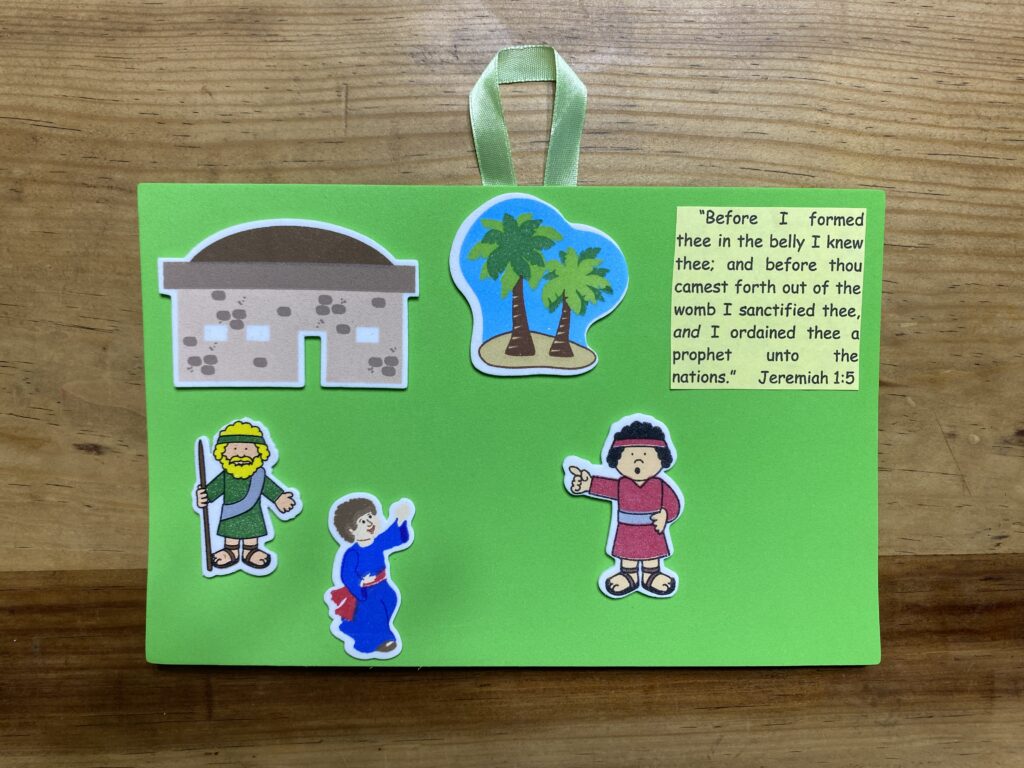
    We made a wall hanging picturing Jeremiah speaking the Word of the Lord to the people.
  • Great is Thy Faithfulness

    22. It is of the LORD’S mercies that we are not consumed, because his compassions fail not. 23. They are new every morning: great is thy faithfulness.
    Lamentations 3:22-23

    Today is a day of uncertainty. The news is full of earthquakes, fires, hurricanes, tornadoes, illnesses, the possibility of food shortages, wars and rumors of wars, and so many other things of which to be fearful. This leads to much apprehension in the world today. I have never known a time when so many people are anxious about almost everything. The constant onslaught can be almost overwhelming!

    Why should a Christian not be afraid?

    What does God’s Word teach us about fear? We are to remember that God is with us. “1. God is our refuge and strength, a very present help in trouble. 2. Therefore will not we fear, though the earth be removed, and though the mountains be carried into the midst of the sea; 3. Though the waters thereof roar and be troubled, though the mountains shake with the swelling thereof” (Psalm 46:1-3). If we walk with God, He will be with us.

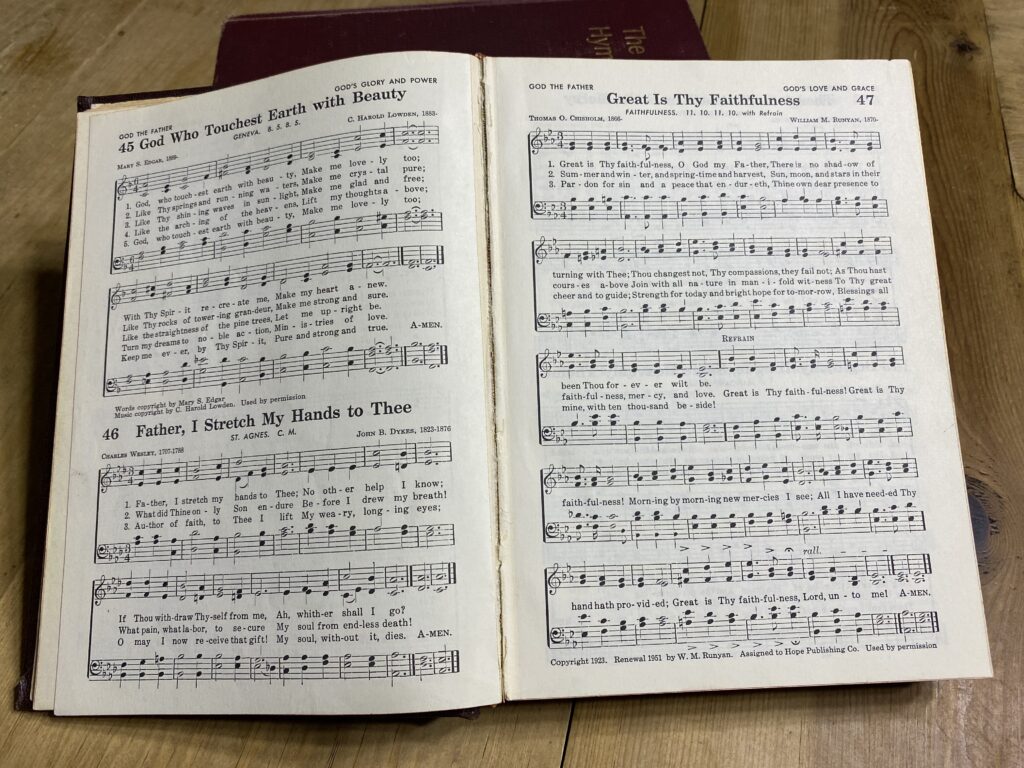
    Jeremiah was a prophet who spoke God’s Word to the Israelite people for around forty years. The people were not walking with God, and it was a time of much trouble in the land. Eventually, the enemies came, destroyed Jerusalem, and carried the people away captive. Jeremiah witnessed these events. Although he had warned the people of the coming invasion, they had not heeded his warnings to turn back to God. The whole nation suffered because of this – even Jeremiah. Understandably, Jeremiah was greatly saddened with these events. Jeremiah wrote the following as he witnessed God’s judgment upon His people for their continual rejection of His Word: “The LORD is righteous; for I have rebelled against his commandment: hear, I pray you, all people, and behold my sorrow …” (Lamentations 1:18a). He wrote the book of Lamentations, revealing the horrors he witnessed, and the sorrow in his heart. Yet in the midst of that sad book, he reminded us of a very pleasant hope. “22. It is of the LORD’S mercies that we are not consumed, because his compassions fail not. 23. They are new every morning: great is thy faithfulness. 24. The LORD is my portion, saith my soul; therefore will I hope in him. 25. The LORD is good unto them that wait for him, to the soul that seeketh him” (Lamentations 3:22-25). Jeremiah knew God was with him. He understood that God is a forgiving God – even when we fail Him miserably! Have you heard the song we often sing in churches written from these verses? Great is Thy Faithfulness. Read the following encouraging words:

    1. Great is Thy faithfulness, O God my Father, There is no shadow of turning with Thee;

    Thou changest not, Thy compassions they fail not; As Thou has been Thou forever wilt be.

    2. Pardon for sin and a peace that endureth, Thine own dear presence to cheer and to guide;

    Strength for today and bright hope for tomorrow, Blessings all mine, with ten thousand beside!

    Refrain: Great is Thy faithfulness! Great is Thy faithfulness! Morning by morning new mercies I see;

    All I have needed Thy hand hath provided; Great is Thy faithfulness, Lord, unto me! Amen!

    It is easy to constantly be distracted by the relentless onslaught of bad news. As one hears the new potential crisis almost every day, it is hard to focus one’s thoughts upon God and the things of God. When we forget God and begin to focus upon the troubles of the world, the problems can appear to be overwhelming. It is before one reaches this point that a decision must be made. What must a Christian decide? To trust God! It is then that when all of the troubles of the world seem to come against us, we can stop and be at rest knowing God is in control. “Be still, and know that I am God: I will be exalted among the heathen, I will be exalted in the earth” (Psalm 46:10). We will then remember that God will take care of His own. “5. Trust in the LORD with all thine heart; and lean not unto thine own understanding. 6. In all thy ways acknowledge him, and he shall direct thy paths. 7. Be not wise in thine own eyes: fear the LORD, and depart from evil” (Proverbs 3:5-7). We are to fear the Lord, doing what His Word says to do. That should be rather easy – for if we walk with God, we will depart from evil.

    Christians should not be so entangled in the troubles of the day that one forgets to walk with (and especially trust) God. Turn off the news and read the Bible. Remember: “… his compassions fail not. 23. They are new every morning: great is thy faithfulness” (Lamentations 3:22-23). Also keep in mind: “The LORD is good unto them that wait for him, to the soul that seeketh him” (Lamentations 3:25). It is important for Christians to seek the Lord and not the potential troubles of the day.

    Do you seek the Lord, understanding that if we walk with Him, He will be faithful?