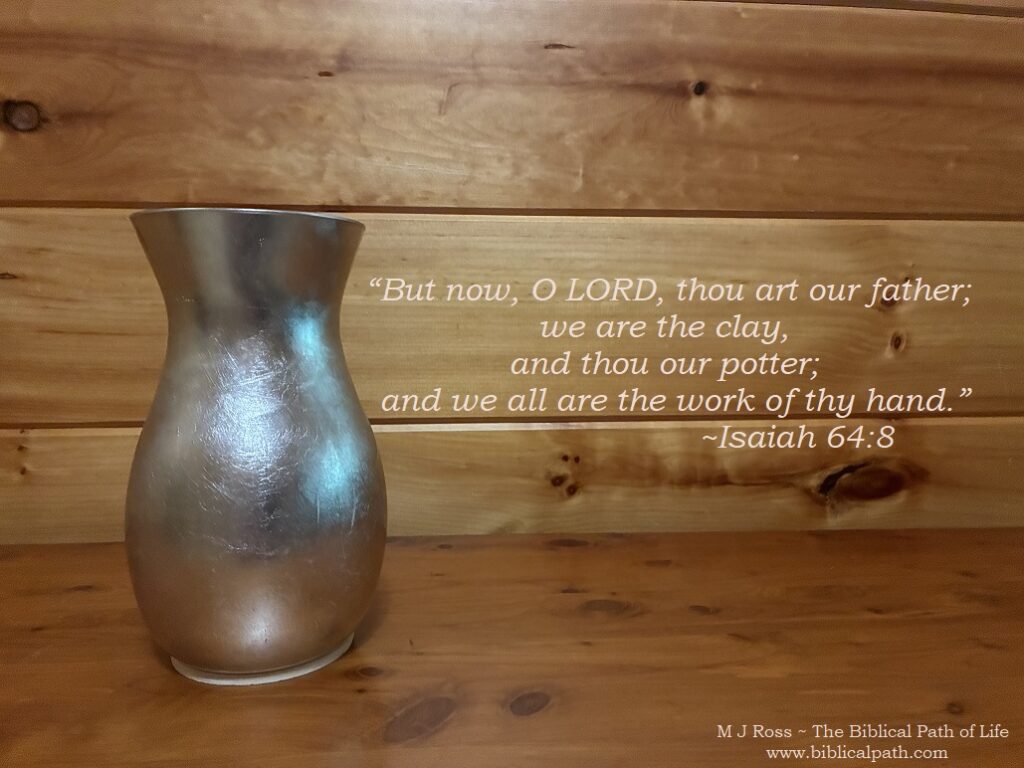
“But in a great house there are not only vessels of gold and of silver, but also of wood and of earth; and some to honour, and some to dishonour.”
2 Timothy 2:20
God had sent Jeremiah to watch a potter work a piece of clay, making it into a vessel (see Jeremiah 18:1-4). Jeremiah recognized that God is the Potter and we are the clay. The Potter took the clay and fashioned it into a vessel to be used. We understand this to be a picture of God dealing with individual people. Our choice: to receive or reject God’s work.
God deals with patience and mercy with all vessels. Notice that He deals with them – not as lifeless clay, but as creatures with a free will. Why? “Who will have all men to be saved, and to come unto the knowledge of the truth” (1 Timothy 2:4). God has unlimited power over the clay. Yet, He allows freedom; God will yield to our choice. He gives ample opportunity to reveal any inclination one might have of obeying God. We gain some insight into this in Romans. “20. Nay but, O man, who art thou that repliest against God? Shall the thing formed say to him that formed it, Why hast thou made me thus? 21. Hath not the potter power over the clay, of the same lump to make one vessel unto honour, and another unto dishonour?” (Romans 9:20-21). Honor means “by analogy esteem (especially of the highest degree), or the dignity itself.” Dishonor means “it refers to dishonor, disgrace.” Take note that the clay is in His hand and under His control, yet while working with the individual, God gives ample opportunity to reveal any inclination that one might have of obeying God. Nevertheless, there are those who challenge the Potter (God). Some clay (vessel) that God is shaping will not take His designing. But, God is long-suffering. “The Lord is not slack concerning his promise, as some men count slackness; but is longsuffering to us-ward, not willing that any should perish, but that all should come to repentance” (2 Peter 3:9). Some rebel against God’s plan, and that one continues on under the judgment of the God it questions. God hates sin and it must be dealt with, but His mercy goes out to the vessel involved. If we insist upon destroying ourselves, He will allow us to do that. If we insist upon not being repentant, and instead choose to be disobedient and/or rebellious, He will give us our desire – at least the fruits of that choice. Yet, God patiently waits for His people to allow Him to shape and mold them into what He wants them to be. Keep in mind: The Potter has an intended purpose for us. He has a goal. We may frustrate that goal. Remember that some become vessels of honor, some vessels of dishonor.
Understanding there are vessels of honor and dishonor, read the following verses: “But in a great house there are not only vessels of gold and of silver, but also of wood and of earth; and some to honour, and some to dishonour” (2 Timothy 2:20).Vessels of gold and silver are vessels of honor. Read a description of such a one from Psalms. “23. The steps of a good man are ordered by the LORD: and he delighteth in his way. 24. Though he fall, he shall not be utterly cast down: for the LORD upholdeth him with his hand” (Psalm 37:23-24). Vessels of wood and earth are vessels of dishonor. One can recognize a vessel of dishonor in Isaiah. “Woe unto him that striveth with his Maker! Let the potsherd strive with the potsherds of the earth. Shall the clay say to him that fashioneth it, What makest thou? or thy work, He hath no hands?” (Isaiah 45:9). When we refuse God’s will, we are injuring ourselves, or depriving ourselves of the joy and satisfaction of being where God wants us to be, fulfilling His purpose for our lives . Remember: “For we are his workmanship, created in Christ Jesus unto good works, which God hath before ordained that we should walk in them” (Ephesians 2:10). God has a plan. It is our job, as Christians, to submit to Him and walk in it (see also 2 Timothy 2:21). The key to what kind of a vessel we will be is determined by how we respond to the Potter’s touch and our obedience to His Word. “23. And whatsoever ye do, do it heartily, as to the Lord, and not unto men; 24. Knowing that of the Lord ye shall receive the reward of the inheritance: for ye serve the Lord Christ. 25. But he that doeth wrong shall receive for the wrong which he hath done: and there is no respect of persons” (Colossians 3:23-25). There are many who refuse to submit fully to God and His Word. The defects are not in the Potter but in the clay.
The following song is a great reminder of this lesson.
Have Thine own way, Lord!
Author: Adelaide A. Pollard (1906)
1. Have Thine own way, Lord! Have Thine own way!
Thou art the Potter, I am the clay.
Mold me and make me After Thy will,
While I am waiting, Yielded and still.
2.Have Thine own way, Lord! Have Thine own way!
Search me and try me, Master today!
Whiter than snow, Lord, Wash me just now,
As in Thy presence Humbly I bow.
3.Have Thine own way, Lord! Have Thine own way!
Wounded and weary, Help me I pray!
Power, all power, Surely is Thine!
Touch me and heal me, Saviour divine!
4.Have Thine own way, Lord! Have Thine own way!
Hold o’er my being, Absolute sway!
Fill with Thy Spirit, Till all shall see
Christ only, always, Living in me!
Are you where God wants you to be, submitting to the Potter’s hand, fulfilling what He has planned for your life?