Tag: Philemon

  • Lesson 3: Maintain Christian Living: Titus and Philemon

    Key Verse

    This is a faithful saying, and these things I will that thou affirm constantly, that they which have believed in God might be careful to maintain good works. These things are good and profitable unto men.

    —Titus 3:8

    Key Verse Thought: Read the Key Verse for this lesson. We will learn that the message within this lesson is one that Paul found necessary to “affirm constantly,” so that they would not forget. It is important for Christians continually to live a Christ-like life (“be careful to maintain good works”). It is profitable for all: for those who maintain those good works; and for those who see Christians living right.

    Emphasis: We are to understand the importance not only of becoming a Christian, but the expectations of Christians within the church. But more than that, the decision each Christian must make to choose to continually live for Christ; “to maintain good works.”

    Lesson Summary: In our last couple of lessons, we have learned that Christians are to live as soldiers, fighting the good fight of faith. We also discovered that it is not always easy. In this lesson, we continue with the importance of maintaining “good works.”

    Titus: Paul won Titus to the Lord early in his ministry. Titus was a Gentile. He went with Paul on a missionary journey, and Paul left him in Crete to help organize a church. Paul wrote this letter to help Titus understand the office of a pastor (bishop), to beware of false teachers in the church, and the basics of Christian living. Paul continued with the description of the kind of behavior expected of Christians, particularly to specific individuals and their obligations in teaching others. Paul encouraged them to remember the importance of knowing that their salvation was a gift of God, and it was not something they could gain by doing works. Christians were to maintain good works, living a right life in Christ.

    Philemon: Philemon was another close friend of Paul’s. This letter was specifically written to encourage Philemon to forgive and receive his runaway slave, Onesimus – for Onesimus had become a Christian. He had ministered to Paul, and now Paul was sending him to Philemon as a brother in Christ. In this letter, notice that Philemon is called to put into practice some of the Christ-like qualities of which we have learned. It is not always easy to choose to do what is right, but it is very important – as Paul made clear to Philemon.

    If you are teaching this to a class, Teachers Note: In this lesson, there is much information of how the different people within the church are to live. Choose the information that would be most relevant, and informative, to your individual class. There is much too much information to be thoroughly studied in one lesson to cover it all. Be sure your students understand the importance of maintaining right Christian living.

    Y3Q4 – Lesson 3 Questions

    Y3Q4 – Lesson 3 Children’s Worksheets

    If you are teaching this to children, the following is a craft idea to help them remember this lesson:
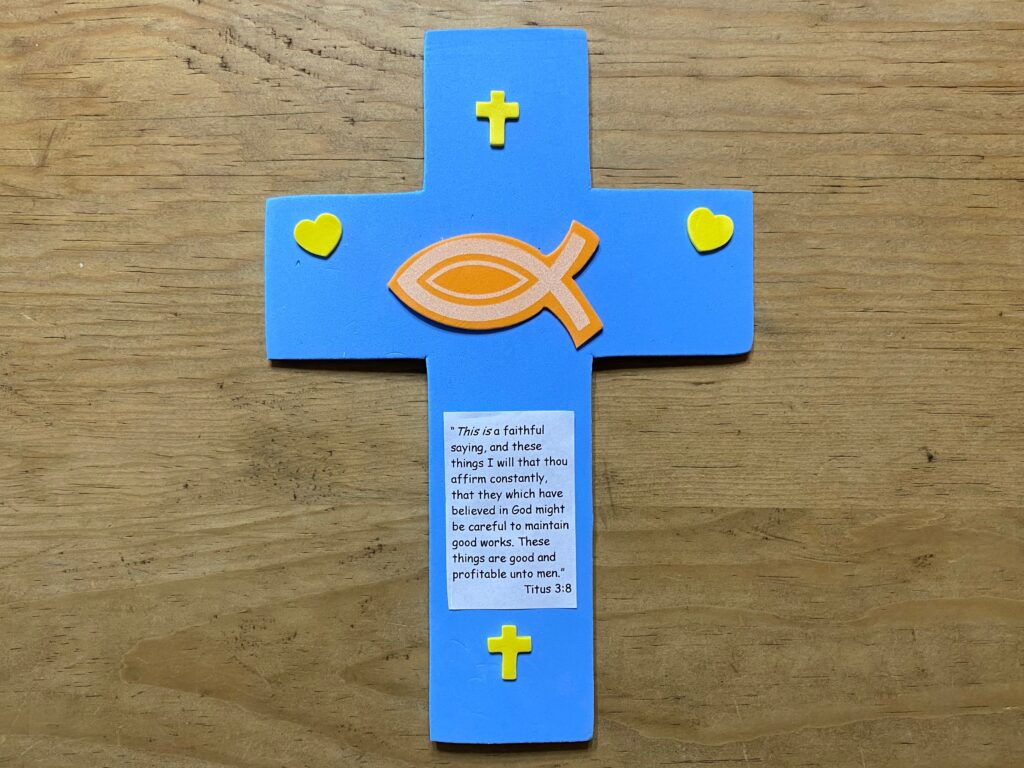
    We decorated a foam cross with stickers and the Key Verse for this lesson.

    The Biblical Path of Life – Year Three, Quarter Four is available through Amazon.

  • To Live is Christ

    “For to me to live is Christ, and to die is gain.”
    Philippians 1:21

    Paul wrote a letter to Philemon. Philemon was a Christian and a fellow laborer with Paul and Timothy. “Hearing of thy love and faith, which thou hast toward the Lord Jesus, and toward all saints” (Philemon 1:5). Philemon was a faithful Christian, and Paul acknowledged the love and faith revealed in his life. Paul prayed for him. “6. That the communication of thy faith may become effectual by the acknowledging of every good thing which is in you in Christ Jesus. 7. For we have great joy and consolation in thy love, because the bowels of the saints are refreshed by thee, brother” (Philemon 1:6-7). Paul specifically wrote Philemon of the importance not only telling of others of his faith in Christ, but he also encouraged him to live a life of faith. By living a life that pleased Christ, he was to understand that it encouraged other believers. This is important for Christians to recognize today, too.

    Previously, Paul had written words of encouragement to help the church at Philippi to live more Christ-like. These words are just as important for Christians, today. “And this I pray, that your love may abound yet more and more in knowledge and in all judgment” (Philippians 1:9). Christians are called to love fellow Believers. However, it is important to understand a few things. The following definitions will help understand what Paul was trying to help them understand.

    • Knowledge means “the knowledge which enables one to avoid error.”
    • Judgment means “knowledge based upon experience; to become cognizant of; experiential knowledge which is or becomes naturally manifold.”

    It is important to avoid error, and often times that comes from becoming aware of situations. He wanted them to know God’s Word and become Christ-like enough to be able to avoid certain things.

    In these things, Paul wanted them to continue growing as they had. Why? “That ye may approve things that are excellent; that ye may be sincere and without offence till the day of Christ” (Philippians 1:10).

    • Approve means “to put to the proof, or examine by examining and judging; to distinguish.” 
    • Sincere means “to discern.”

    Paul wanted the Christians at Philippi to recognize the things that really mattered “things that are excellent.” By knowing them, they would be able to live more Christ-like, self-checking and discerning right from wrong, without failing. Because Paul loved them, he wanted to encourage and teach them. Each Christian is called to continue to grow in Christ.

    Paul understood that the people at Philippi were concerned for Paul and his safety. The things that had happened to Paul, although they appeared to be bad, Paul understood that they were actually good. Remember when Paul was in Philippi: he cast a spirit of divination out of a young girl, healing her, and it cost him a beating and imprisonment. Nevertheless, that imprisonment, dealt with in the right spirit, was beneficial for a man and his family who came to know Jesus. Because Paul and Silas praised God through song, and the jailer heard, they were able to be a witness to him. Once the jailer heard about Jesus, he was saved and his house. Paul wanted the Philippians to recall this event. “12. But I would ye should understand, brethren, that the things which happened unto me have fallen out rather unto the furtherance of the gospel; 13. So that my bonds in Christ are manifest in all the palace, and in all other places; 14. And many of the brethren in the Lord, waxing confident by my bonds, are much more bold to speak the word without fear” (Philippians 1:12-14). As we have learned, that was not the only time Paul was beaten or imprisoned. However, any thing that happened to Paul that the world would call “bad” or “unlucky,” God used it to further the Gospel message in the way Paul responded in each situation. Instead of becoming afraid of what man could, or would, do to him, he became bolder in speaking out for Jesus – “without fear.

    Paul was a mighty example. Read what he not only believed, but also lived: “20. According to my earnest expectation and my hope, that in nothing I shall be ashamed, but that with all boldness, as always, so now also Christ shall be magnified in my body, whether it be by life, or by death. 21. For to me to live is Christ, and to die is gain” (Philippians 1:20-21). Instead of choosing what he wanted for his life, he chose to live his life for Jesus.

    Have you chosen to live for Christ, that in nothing you shall be ashamed?