
Tag: Perish

  • Believe in Him

    That whosoever believeth in him should not perish, but have eternal life.

    John 3:15

    Almost everyone has either heard or memorized John 3:16:“For God so loved the world, that he gave his only begotten Son, that whosoever believeth in him should not perish, but have everlasting life.” However, have you ever stopped to understand what this verse really means?

    In John 3:16, we are to recognize the way in which God loved the world. Because sin had entered into the world, there was a breach between God and man. The penalty for sin is death (see Romans 6:23). There was only one way to bridge that separation and give life. Because God is a loving and gracious God, He sent His Son, Jesus, into the world.“But God commendeth his love toward us, in that, while we were yet sinners, Christ died for us” (Romans 5:8). God gave His Beloved Son, Jesus, to pay the penalty for each individual person’s sin with His life. All one must do is believe upon Jesus, receiving this great gift. “For God so loved the world, that he gave his only begotten Son, that whosoever believeth in him should not perish, but have everlasting life” (John 3:16). Can you better understand this verse now? Read the next verse in that passage to understand even better as to why Jesus came: “For God sent not his Son into the world to condemn the world; but that the world through him might be saved” (John 3:17).

    After reading both of those verses, understand that the gift of the pardon for sin is offered – all one has to do is receive it. This pardon from sin is understood as a promise from God – but only for those who accept that gift. God wanted each person in the world to be saved from the penalty of sin, however God allows each person to make the choice: believe unto salvation or believe not (“He that believeth on him is not condemned: but he that believeth not is condemned already, because he hath not believed in the name of the only begotten Son of God” John 3:18).

    Why would God, who is known for His great love, condemn people? Each person was already condemned because of that separation. God provided the way to be saved – leaving the decision up to each individual. People condemn themselves when they choose to not believe in Jesus (the Light, see John 8:12) and continue in sin. “And this is the condemnation, that light is come into the world, and men loved darkness rather than light, because their deeds were evil” (John 3:19). Those who choose to not believe, love darkness – because their deeds are evil. Surprisingly, many people enjoy sin.

    What if one chooses to continue in sin, rejecting the gift God offered? John summed up the consequences of rejecting this gift of Jesus in the last verse of that chapter. It tells what becomes of one who does not believe that Jesus came and died, living again, enabling Him to take away the sin of each individual who would only believe. “He that believeth on the Son hath everlasting life: and he that believeth not the Son shall not see life; but the wrath of God abideth on him” (John 3:36). This, too, is a promise.

    No one talks about the wrath of God anymore. What exactly is the wrath of God? It is mentioned most often in the New Testament. One clear understanding of it is found in the reading of Romans chapter one. In that chapter, one can understand that God’s wrath is holy and just in its’ indignation against sin. It is so much more than just anger at the willingness of people to continue in sin, it is extreme anger mingled with disgust or abhorrence of that sin.

    How can one escape the wrath of God. and choose this gift God offered? Remember what Jesus declared: “That whosoever believeth in him should not perish, but have eternal life” (John 3:15). It is declared simply in the Scriptures: “9. That if thou shalt confess with thy mouth the Lord Jesus, and shalt believe in thine heart that God hath raised him from the dead, thou shalt be saved. 10. For with the heart man believeth unto righteousness; and with the mouth confession is made unto salvation” (Romans 10:9-10). Because one receives the Lord Jesus, believing by faith, that one will be saved from God’s wrath. “Much more then, being now justified by his blood, we shall be saved from wrath through him” (Romans 5:9).

    Life is fleeting and short. No one knows what tomorrow may hold. It is up to each individual to decide. Choose life (eternal with Jesus), or receive the penalty for sin – the wrath of God abiding on him.

    Each person has a choice to make:

    • Believe on the Son and have everlasting life, or
    • Believe not the Son and have the wrath of God abide upon them.

    Have you chosen to receive the gift of salvation (life) by believing in Jesus?
  • The Spirit

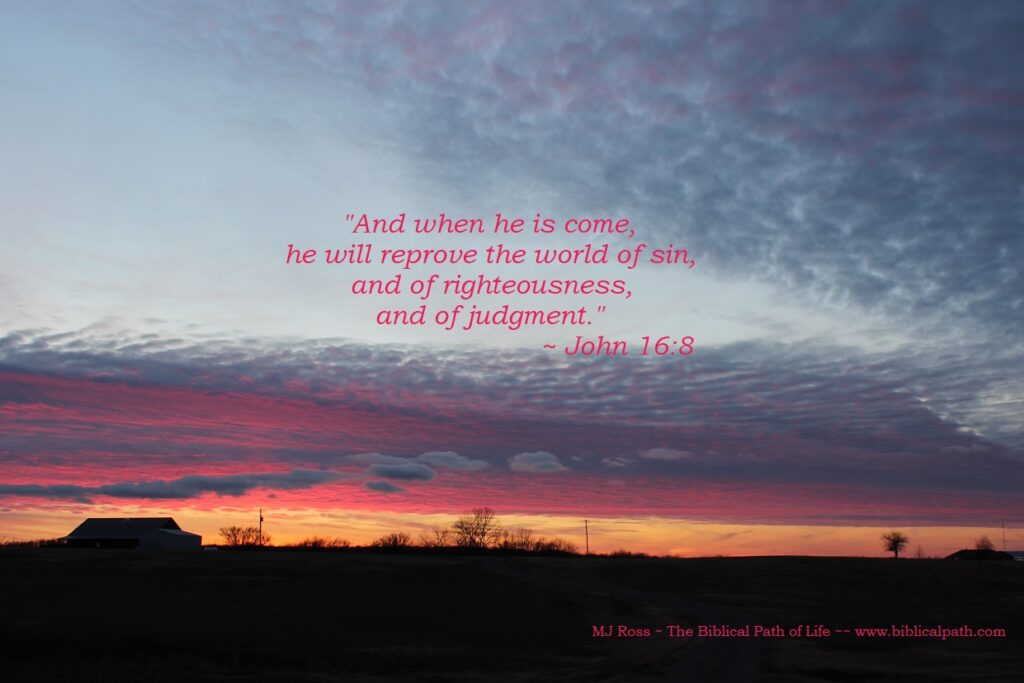
    And when he is come, he will reprove the world of sin, and of righteousness, and of judgment.”

    John 16:8

    Before Jesus left this world, He made a promise to send the Comforter, the Holy Spirit. The Spirit of God has specific jobs. Read what Jesus declared to His disciples. “7. Nevertheless I tell you the truth; It is expedient for you that I go away: for if I go not away, the Comforter will not come unto you; but if I depart, I will send him unto you. 8. And when he is come, he will reprove the world of sin, and of righteousness, and of judgment” (John 16:7-8). The Holy Spirit has come to reprove (convict) the world of sin, of righteousness, and of judgment. Consider if you will: in the world’s court system, first there is a crime, and when it is proven, the judgment (punishment) is determined. I see no righteousness involved.  

    However, with God it is different. The listing in God’s Word says He will convict of sin, then of righteousness, and finally of judgment. God has put righteousness between the sin and the judgment. God has interposed the blood of His Son, Jesus Christ. Nevertheless, if you do not believe in Jesus – if you refuse the gift purchased by His blood, there is no righteousness between sin and judgment. The result of this is one will just receive judgment: death and hell. “13. And the sea gave up the dead which were in it; and death and hell delivered up the dead which were in them: and they were judged every man according to their works. 14. And death and hell were cast into the lake of fire. This is the second death” (Revelation 20:13-14).

    Remember: All have sinned. “For all have sinned, and come short of the glory of God” (Romans 3:23). But those who believe in Jesus have a provision that only God could make by the death of His Son upon the cross. “24. Being justified freely by his grace through the redemption that is in Christ Jesus: 25. Whom God hath set forth to be a propitiation through faith in his blood, to declare his righteousness for the remission of sins that are past, through the forbearance of God; 26. To declare, I say, at this time his righteousness: that he might be just, and the justifier of him which believeth in Jesus” (Romans 3:24). This places Jesus between the sinner and the judgment. Propitiation means “to conciliate; to atone for sin; to make reconciliation for.” If you refuse this propitiation, there is no righteousness between the sin and sinner. Read the description of God telling us what Jesus did for those who believe. “For he hath made him to be sin for us, who knew no sin; that we might be made the righteousness of God in him” (2 Corinthians 5:21). God makes Believers (Christians) the righteousness of God – because of what Jesus did upon the cross.

    We also understand that judgment will come to all. For Believers (Christians), Jesus took our judgment for us. For those who reject Jesus, judgment awaits them at death. “9. Of sin, because they believe not on me; 10. Of righteousness, because I go to my Father, and ye see me no more; 11. Of judgment, because the prince of this world is judged” (John 16:9-11). God’s Spirit has come to reveal sin to man. God’s Spirit came to teach what Christ the Saviour’s provision is – righteousness. Notice also that Satan has already been judged. On that last week when Jesus faced the cross, He declared the judgment of the world. “Now is the judgment of this world: now shall the prince of this world be cast out” (John 12:31). When Jesus died on the cross, Satan lost the war. When it looks like Satan is winning the battle, remember that he has already been judged. All of Satan’s plans are destined for failure. His doom and destiny has been set. Hell was prepared for the devil and his angels. “Then shall he say also unto them on the left hand, Depart from me, ye cursed, into everlasting fire, prepared for the devil and his angels” (Matthew 25:41). It was not prepared for people. However if one fails to repent, becoming conformed to the image of God’s Son, that one will be cast into that everlasting fire – the place we call hell. God does not want anyone to perish, spending eternity in hell. “The Lord is not slack concerning his promise, as some men count slackness; but is longsuffering to us-ward, not willing that any should perish, but that all should come to repentance” (2 Peter 3:9). He is longsuffering – for now.

    But recognize that God’s Spirit is the only one who can tell one’s heart of sin, righteousness and judgment. Moreover, the only sin that keeps one from heaven is the rejection of God’s Spirit that convicts the heart, revealing the need of Jesus. God forgives one who believes, giving what we need: righteousness “3. For what saith the scripture? Abraham believed God, and it was counted unto him for righteousness. … 5. But to him that worketh not, but believeth on him that justifieth the ungodly, his faith is counted for righteousness” (Romans 4:3, 5). Recognize that faith is counted as righteousness. When one believes in Jesus, one becomes a new creature: “Therefore if any man be in Christ, he is a new creature: old things are passed away; behold, all things are become new” (2 Corinthians 5:17).

    Have you heard the conviction of the Holy Spirit, recognizing your need to trust upon Jesus?

    How To Be Saved

  • The Preaching of the Cross

    For the preaching of the cross is to them that perish foolishness; but unto us which are saved it is the power of God.
    1 Corinthians 1:18

    Many times in the Old Testament, we read of the promise of Jesus. No one knew His name, yet God’s people were to be looking for Him the same. At times, God revealed specific things He wanted the people to understand. “Behold, my servant shall deal prudently, he shall be exalted and extolled, and be very high” (Isaiah 52:13). “Behold, my servant” is speaking of Jesus. God said Jesus would “deal prudently” meaning Jesus would succeed in completing what God expected Him to do. Continuing through that verse, see that it says that Jesus will be “exalted and extolled” which means “to raise, or lift up; to carry off; take away; it is the idea of one who is a substitution bearing the guilt or punishment of sin.” So just from that one verse we understand that God told Isaiah that He would send Jesus who would complete the task of being lifted up as the one who would take away the guilt and punishment of sin by becoming the substitute – the one who took sinful man’s place. This is what God had promised Adam and Eve in the garden (see Genesis 3:15).

    They were to be aware of the suffering death that this One would have to endure. Remember that when Jesus came, He was scourged and delivered to be crucified (see Matthew 27:26, 29-30). Why did this happen? “So shall he sprinkle many nations; the kings shall shut their mouths at him: for that which had not been told them shall they see; and that which they had not heard shall they consider” (Isaiah 52:15). Understand that this verse tells us that Jesus’ death would enable Him to “sprinkle” many nations. “Sprinkle many nations” means “to cleanse from sin; the Servant of the Lord came to make an atonement for the sins of even the Gentiles.” In the Old Testament, the people understood the high priest had to sprinkle the blood of the ram upon the altar to cover their sins for another year (see Exodus 29:20). God sent His Son to take away the sin (not cover), and allowed the entire world to “see” and then to “consider.” “See” means “to gain understanding”; and “consider” means “to observe; to pay attention to; to gain insight or understanding.” Each person has to see and decide (believe) for himself.

    Immediately after Jesus death, burial, and resurrection, there were still many who did not understand what had happened, and many did not believe Jesus had even risen from the dead. There were two in particular who were on the road to Emmaus, not far from Jerusalem. On the evening of Jesus’ resurrection, they were walking and discussing all they had heard. Jesus joined them, walking and talking with them, yet they did not recognize Him (see Luke 24:15-16). When He asked what things they were discussing, they explained, “Concerning Jesus of Nazareth, which was a prophet mighty in deed and word before God and all the people: 20. And how the chief priests and our rulers delivered him to be condemned to death, and have crucified him. 21. But we trusted that it had been he which should have redeemed Israel: and beside all this, to day is the third day since these things were done” (Luke 24:19b-21). They were trying to “consider” but did not yet understand. After walking with them, listening to them as they continue their discussion, Jesus responded: “25. Then he said unto them, O fools, and slow of heart to believe all that the prophets have spoken: 26. Ought not Christ to have suffered these things, and to enter into his glory? 27. And beginning at Moses and all the prophets, he expounded unto them in all the scriptures the things concerning himself” (Luke 24:25-27). They needed to believe, by faith. “But to him that worketh not, but believeth on him that justifieth the ungodly, his faith is counted for righteousness” (Romans 4:5).   

    It is almost amazing to those today, who are Believers, to understand how they could not have recognized Jesus. However, many times in the Old Testament people should have understood and recognized what God was doing, yet they most of the time, they did not. All throughout the Old Testament, the people were taught of God, but they had a hard time understanding that He had been speaking of Jesus, who was to come. They lacked faith.

    For the preaching of the cross is to them that perish foolishness; but unto us which are saved it is the power of God” (1 Corinthians 1:18). See the following to help understand what this verse means: 

    • preaching means to speak intelligently about the word of the cross 
    • cross means the whole passion of Christ and the merit of His sufferings and death 
    • them that perish means exposed to eternal death 
    • foolishness means foolishness or absurdity
    • saved means those who have obtained salvation through Christ and are kept by Him 
    • power means a person in whom the power of God is manifested  

    The “power of God” was revealed when Jesus came and finished what God had for Him to do. Jesus came to pay the penalty for sin, taking it away from any who would only believe.

    Have you believed the preaching of the cross, becoming a Christian?

This website stores cookies on your computer. These cookies are used to provide a more personalized experience and to track your whereabouts around our website in compliance with the European General Data Protection Regulation. If you decide to to opt-out of any future tracking, a cookie will be setup in your browser to remember this choice for one year.

Accept or Deny