Tag: Earth

  • Have Thine own way, Lord!

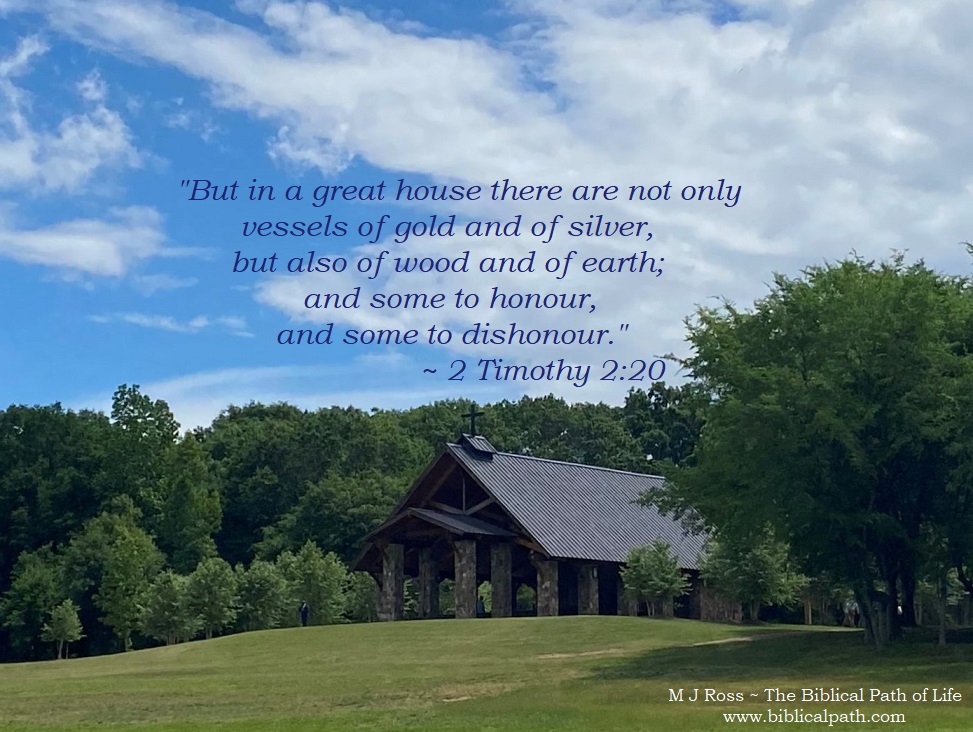
    But in a great house there are not only vessels of gold and of silver, but also of wood and of earth; and some to honour, and some to dishonour.”

    2 Timothy 2:20

    God had sent Jeremiah to watch a potter work a piece of clay, making it into a vessel (see Jeremiah 18:1-4). Jeremiah recognized that God is the Potter and we are the clay. The Potter took the clay and fashioned it into a vessel to be used. We understand this to be a picture of God dealing with individual people. Our choice: to receive or reject God’s work.

    God deals with patience and mercy with all vessels. Notice that He deals with them – not as lifeless clay, but as creatures with a free will. Why? “Who will have all men to be saved, and to come unto the knowledge of the truth” (1 Timothy 2:4). God has unlimited power over the clay. Yet, He allows freedom; God will yield to our choice. He gives ample opportunity to reveal any inclination one might have of obeying God. We gain some insight into this in Romans. “20. Nay but, O man, who art thou that repliest against God? Shall the thing formed say to him that formed it, Why hast thou made me thus? 21. Hath not the potter power over the clay, of the same lump to make one vessel unto honour, and another unto dishonour?” (Romans 9:20-21). Honor means “by analogy esteem (especially of the highest degree), or the dignity itself.Dishonor means “it refers to dishonor, disgrace.” Take note that the clay is in His hand and under His control, yet while working with the individual, God gives ample opportunity to reveal any inclination that one might have of obeying God. Nevertheless, there are those who challenge the Potter (God). Some clay (vessel) that God is shaping will not take His designing. But, God is long-suffering. “The Lord is not slack concerning his promise, as some men count slackness; but is longsuffering to us-ward, not willing that any should perish, but that all should come to repentance” (2 Peter 3:9). Some rebel against God’s plan, and that one continues on under the judgment of the God it questions. God hates sin and it must be dealt with, but His mercy goes out to the vessel involved. If we insist upon destroying ourselves, He will allow us to do that. If we insist upon not being repentant, and instead choose to be disobedient and/or rebellious, He will give us our desire – at least the fruits of that choice. Yet, God patiently waits for His people to allow Him to shape and mold them into what He wants them to be. Keep in mind: The Potter has an intended purpose for us. He has a goal. We may frustrate that goal. Remember that some become vessels of honor, some vessels of dishonor.

    Understanding there are vessels of honor and dishonor, read the following verses: “But in a great house there are not only vessels of gold and of silver, but also of wood and of earth; and some to honour, and some to dishonour” (2 Timothy 2:20).Vessels of gold and silver are vessels of honor. Read a description of such a one from Psalms. “23. The steps of a good man are ordered by the LORD: and he delighteth in his way. 24. Though he fall, he shall not be utterly cast down: for the LORD upholdeth him with his hand” (Psalm 37:23-24). Vessels of wood and earth are vessels of dishonor. One can recognize a vessel of dishonor in Isaiah. “Woe unto him that striveth with his Maker! Let the potsherd strive with the potsherds of the earth. Shall the clay say to him that fashioneth it, What makest thou? or thy work, He hath no hands?” (Isaiah 45:9). When we refuse God’s will, we are injuring ourselves, or depriving ourselves of the joy and satisfaction of being where God wants us to be, fulfilling His purpose for our lives . Remember: “For we are his workmanship, created in Christ Jesus unto good works, which God hath before ordained that we should walk in them” (Ephesians 2:10). God has a plan. It is our job, as Christians, to submit to Him and walk in it (see also 2 Timothy 2:21). The key to what kind of a vessel we will be is determined by how we respond to the Potter’s touch and our obedience to His Word. “23. And whatsoever ye do, do it heartily, as to the Lord, and not unto men; 24. Knowing that of the Lord ye shall receive the reward of the inheritance: for ye serve the Lord Christ. 25. But he that doeth wrong shall receive for the wrong which he hath done: and there is no respect of persons” (Colossians 3:23-25). There are many who refuse to submit fully to God and His Word. The defects are not in the Potter but in the clay.

    The following song is a great reminder of this lesson.

    Have Thine own way, Lord!

    Author: Adelaide A. Pollard (1906)

    1. Have Thine own way, Lord! Have Thine own way!
    Thou art the Potter, I am the clay.
    Mold me and make me After Thy will,
    While I am waiting, Yielded and still.

    2.Have Thine own way, Lord! Have Thine own way!
    Search me and try me, Master today!
    Whiter than snow, Lord, Wash me just now,
    As in Thy presence Humbly I bow.

    3.Have Thine own way, Lord! Have Thine own way!
    Wounded and weary, Help me I pray!
    Power, all power, Surely is Thine!
    Touch me and heal me, Saviour divine!

    4.Have Thine own way, Lord! Have Thine own way!
    Hold o’er my being, Absolute sway!
    Fill with Thy Spirit, Till all shall see
    Christ only, always, Living in me!

    Are you where God wants you to be, submitting to the Potter’s hand, fulfilling what He has planned for your life?
  • What will He Find?

    I tell you that he will avenge them speedily. Nevertheless when the Son of man cometh, shall he find faith on the earth?

    Luke 18:8

    Jesus told a parable about a woman who persistently cried to a judge day and night to “Avenge me of mine adversary” (see Luke 18:1-5). The judge would not, but after time passed, the judge agreed to avenge her “lest by her continual coming she weary me.” Because the woman repeatedly asked this of the judge, he granted her request. Jesus said to hear what the unjust judge said. Jesus wanted the people to understand something important.

    Jesus had just been teaching His disciples of the end times, and His coming kingdom (see Luke 17:20-37). He wanted them to know what was expected of them. God hears His people, and He will avenge them of their adversaries – if only they will ask it of Him. Do Christians have adversaries? We all know Satan is our Adversary (1 Peter 5:8). We are instructed to cast all of our cares upon Him (Jesus) (see 1 Peter 5:7), and then we are able to recognize that our adversary, the devil, is trying to destroy us. We are able to cast our cares upon Jesus through prayers. “And shall not God avenge his own elect, which cry day and night unto him, though he bear long with them?” (Luke 18:7). God desires that we take our requests to Him. Jesus is declaring that God’s people are to pray, with faith, that God will hear and answer, and Christians are to persevere in those prayers. We know that there are many adversaries – especially in the world today. Many Christians are persecuted and oppressed revealing a great need for prayer in these days “… but the prayer of the upright is his delight” (Proverbs 15:8b). Often times in Scripture, we are encouraged to ask for what we need. Remember what Jesus said, “Again I say unto you, That if two of you shall agree on earth as touching any thing that they shall ask, it shall be done for them of my Father which is in heaven” (Matthew 18:19). God will hear our prayers. Yet often times, we fail to pray. However worse than that, we fail to pray correctly. There is something very important that Jesus is looking for in Christians. “Watch ye and pray, lest ye enter into temptation. The spirit truly is ready, but the flesh is weak” (Mark 14:38). Jesus spoke the same thought in Matthew and Luke. In John, Jesus prayed this prayer for his disciples: “14. I have given them thy word; and the world hath hated them, because they are not of the world, even as I am not of the world. 15. I pray not that thou shouldest take them out of the world, but that thou shouldest keep them from the evil” (John 17:14-15). In these words, Christians are to understand that in our spirit, we are ready to be the best Christian we can be. Yet temptation is ever before us to fail in that respect. Jesus prayed that Christians would be kept from the evil that is in this world.

    The end of the parable about the widow and the unrighteous judge ends with this though. “I tell you that he will avenge them speedily. Nevertheless when the Son of man cometh, shall he find faith on the earth?” (Luke 18:8). At the end of time, when Jesus returns, will He find anyone of faith on the earth? To better understand what this means, read what the word faith means. Faith means “appropriating what God in Christ has for man resulting in the transformation of man’s character and way of life; marking various predominant traits of Christian character as arising from and combined with Christian faith; meaning Christian knowledge.” Honestly, are there many “Christians” living this kind of faith in our world today? Have many Christians appropriated what God has for us, resulting in the transformation of our character and way of life?

    Remember what Paul wrote as an encouragement on what it is that a Christian is called to do: “12. Not as though I had already attained, either were already perfect: but I follow after, if that I may apprehend that for which also I am apprehended of Christ Jesus. 13. Brethren, I count not myself to have apprehended: but this one thing I do, forgetting those things which are behind, and reaching forth unto those things which are before, 14. I press toward the mark for the prize of the high calling of God in Christ Jesus. 15. Let us therefore, as many as be perfect, be thus minded: and if in any thing ye be otherwise minded, God shall reveal even this unto you” (Philippians 3:12-15). We must forget the things behind and press forward to the “high calling of God in Christ Jesus.” We must live in faith, “appropriating what God in Christ has for man resulting in the transformation of man’s character and way of life.

    Do not be discouraged.

    Be transformed, by faith, into what Christ wants you to be in Him.

    Have you appropriated what God in Christ has for you, resulting in the transformation of your character to be like Jesus?

    http://biblicalpath.com/index.php/how-to-be-saved/

  • Through Faith Understand

    Through faith we understand that the worlds were framed by the word of God, so that things which are seen were not made of things which do appear.
    Hebrews 11:3

    Now faith is the substance of things hoped for, the evidence of things not seen” (Hebrews 11:1). This verse has appeared in prominent places on many plaques or posters. However, have you ever considered what these words actually mean? To what faith is this verse referring?

    Faith is the substance of things hoped for, the evidence of things not seen means “that persuasion is not the outcome of imagination, but it is based on fact; such as the reality of the resurrection of Christ, and as such it becomes the basis of realistic hope.” Many people who lived in Old Testament times believed that Jesus would come (because God had made that promise). Although they did not live to see the fulfillment of that promise, they lived lives declaring they believed that promise: a life of faith. Consider what Jesus said when He was speaking to the religious leaders in the book of John. “Your father Abraham rejoiced to see my day: and he saw it, and was glad” (John 8:56). Jesus, Himself, recognized Abraham as one who looked forward to His coming. This kind of faith led to the comment in the next verse: “For by it the elders obtained a good report” (Hebrews 11:2). Not only do we understand these people lived believing the promises God made, by faith, today we know that Jesus came – just as God promised.

     However, the following verse is often overlooked: “Through faith we understand that the worlds were framed by the word of God, so that things which are seen were not made of things which do appear” (Hebrews 11:3). The fact that God created the heaven and the earth from nothing in six days and rested on the seventh is challenged in our world today. Other theories are taught, yet none of them has been proven. God, Himself, declared that He created all. “In the beginning God created the heaven and the earth” (Genesis 1:1). This is the first thing that He declared to us. This is the first step of faith. If one does not believe that God created the heaven and the earth, how will one ever believe the rest of the Bible? It is interesting to note that this fact is reiterated right here in Scripture, helping us understand the importance of believing all of the Word of God. This first step of faith will allow one to begin to understand that God loved His creation (man) so much, that He willingly sent His Son, Jesus, to restore the relationship broken by man’s sin. 

    Those people recorded in the eleventh chapter of the book of Hebrews, believed, by faith, that God created the world. This was the first step of faith. They were then able to believe God’s promises by faith. “But without faith it is impossible to please him: for he that cometh to God must believe that he is, and that he is a rewarder of them that diligently seek him” (Hebrews 11:6). We find a great list of people who diligently sought God and lived by faith. Many names listed should be quite familiar: Abel, Enoch, Noah, Abraham, Sarah, Isaac, Jacob, Joseph, Moses, and many others. While reading that listing of faithful men and women from the Old Testament, there are interjections by the writer, helping understand the importance of faith. Remember that the people of faith from the Old Testament believed the promise that God would send One, Jesus, who would bring reconciliation between man and God.

    Each of the people on that list diligently sought God, trusting that God would reward them for their faithfulness to Him, for they looked forward to Jesus’ coming. “These all died in faith, not having received the promises, but having seen them afar off, and were persuaded of them, and embraced them, and confessed that they were strangers and pilgrims on the earth” (Hebrews 11:13).

    • Persuaded means “to be convinced; to believe.” 
    • Embraced means “to welcome; to receive gladly – referring to the promises.”

    These people lived by faith. Read how we are to understand this active participation of faith in one’s life by the following verses: “6. As ye have therefore received Christ Jesus the Lord, so walk ye in him: 7. Rooted and built up in him, and stablished in the faith, as ye have been taught, abounding therein with thanksgiving” (Colossians 2:6-7).

    • faith means “a knowledge of, assent to, and confidence in certain divine truths, especially those of the Gospel, as produces good works.”
    • stablished means “to turn resolutely in a certain direction; strengthen.

    One must actively become “stablished” in that faith.

    Chapter eleven of Hebrews is often called the “Hall of Faith” because of the many Old Testament men and women who were commended for this faith. They believed God and His Word. These men and women can help one understand the importance of trusting in Christ, who came as God promised, to restore the life that had been lost because of sin. Not only that, but because of their faith, Christians can look back to their perseverance, lending strength in unsure times.

    Have you taken the first step of faith, believing that God created the heaven and earth, enabling you to trust in God’s Son, Jesus?

    Do you remember those who were commended for their faith, allowing them to encourage you in your Christian life?

    http://biblicalpath.com/index.php/how-to-be-saved/