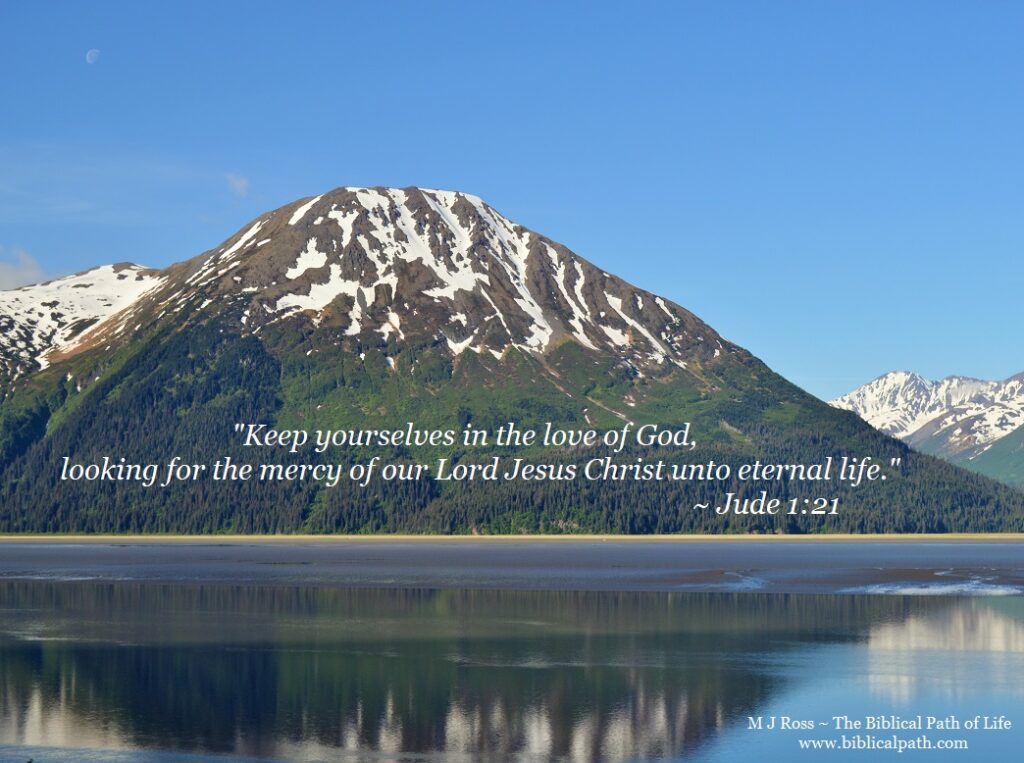
Keep yourselves in the love of God, looking for the mercy of our Lord Jesus Christ unto eternal life.
—Jude 1:21
Key Verse Thought: Read the Key Verse. As we look at the book of Jude in this lesson, we will understand that he warned of apostasy, or abandonment of God’s truth. As we read, we will learn that this apostasy comes mainly because of false teachers and unbelievers. After reading the Key Verse, we are to recognize that the only way to stay with the truth of God’s Word is to do what this verse teaches – especially to “Keep yourselves in the love of God”. Doing this is what will help us not to believe false teachers who oppose God and the things of God
Emphasis: As we look at this lesson, we are to understand that there will be false teaching, but Christians are to contend for the integrity of the truth of God’s Word. In Jude, we are to remember the judgment that befell upon those who rejected God’s Word. Christians are to keep themselves in the love of God, obeying God’s Word, as a witness to the lost world.
Lesson Summary: The book of Jude is the eighth book in the final division of the New Testament: The Nine General Letters to the Jewish Church. Jude, who was also the half brother of Jesus, wrote it.
Jude called for Christians earnestly to contend for the faith. He wrote warnings to Christians that there were false teachers who had not only rebelled against the teachings of Jesus, but that were leading people from the truth of the Gospel message. This is called apostasy. In order for Christians to understand just what apostasy is, Jude remembered a few previous apostasies: the Israelites in the wilderness, one-third of the angels, and the cities of Sodom and Gomorrha. Jude then recognized the apostasy that was occurring in his day. He compared this apostasy with three: Cain, Balaam, and Korah.
Jude then recalled the life of Enoch, the seventh from Adam. He not only walked with God daily, but he understood and preached against the ungodly. Enoch understood that the Lord would return one day – and he warned others.
After remembering that God knew apostasy would come, Christians are encouraged to build their lives upon the Christian faith and keep themselves in the love of God. By living a Christ-like life, Christians can be a witness to the lost world – and Christians are commanded to live a life that makes a difference in others by revealing Jesus to them. God will hold Christians accountable for this.
Jude ended with the promise that God would enable Christians to do these things.
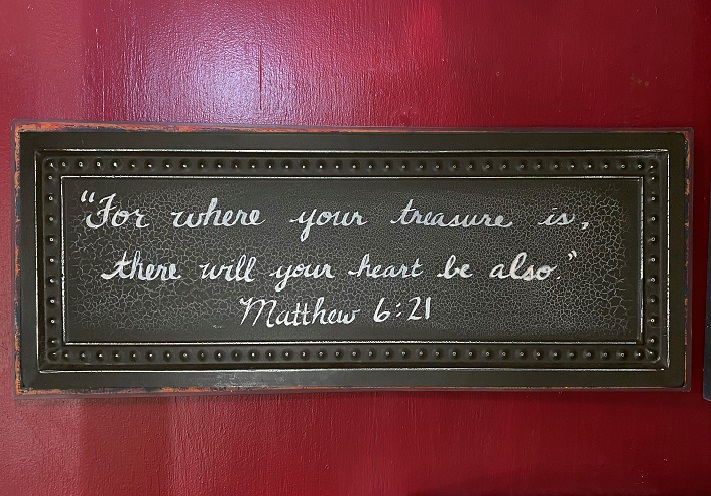
“For where your treasure is, there will your heart be also.” Matthew 6:21
Have you ever encountered one
called a Christian, who chooses the ways and riches of this present world
instead of walking a Christ-like life? This brings to mind a very real man named
Balaam from the book of Numbers in the Old Testament.
Balak, king of Moab, (along with all of the Moabites) were afraid of the
Israelites, God’s people. Balak sent for Balaam. He wanted Balaam to curse
God’s people. Balak had heard that whomever Balaam cursed was cursed, and
whomever he blessed was blessed. Balak sent money with men to give Balaam as
payment to come to him and curse the Israelites. God spoke to Balaam and told
him not to go with the men and not to curse God’s
people, for they were a blessed people. Balaam told the princes of Balak to go
home. God would not allow him to go with them.
Balak sent more men to tell
him not to let anything keep him from coming to him – even giving promises of
great honor. “And Balaam answered and said unto the servants of Balak, If Balak would
give me his house full of silver and gold, I cannot go beyond the word of the
LORD my God, to do less or more”
(Numbers 22:18). Yet Balaam told the men to stay the night, and wait to see
what God would tell him that night. “And God came unto Balaam at night, and said unto
him, If the men come to call thee, rise up, and go with them; but yet
the word which I shall say unto thee, that shalt thou do” (Numbers 22:20).
God had already told Balaam
not to go. God’s people were only to be blessed, for they were a blessed
people. Yet when Balaam was offered honor, a house full of silver and gold, he
told the men to wait. Why is that? Do you think he was hoping God would let him
go so he could have all of that honor and gold? That night, God told him to go.
Do you think that maybe this could have been a test to see what was in Balaam’s
heart? Balaam went. “And God’s anger was kindled because he went: and the angel of the LORD
stood in the way for an adversary against him …” (Numbers 22:22a). Balaam heard what
God said, but he was not listening to what God had told him. God
was angry with him for going.
Balaam rode his donkey,
heading to see Balak, king of Moab. The donkey saw the angel of the Lord standing in the
way, but Balaam did not. The donkey understood that he was not to continue
forward. Balaam was angry at his donkey, and began to hit the donkey when it
sat down (Numbers 22:23).
The donkey was trying to save his master’s life. God opened the mouth of that
donkey, and he spoke to Balaam. And Balaam answered the donkey. He told the
donkey that if he had a sword in his hand, he would kill him. “Then the LORD opened the
eyes of Balaam, and he saw the angel of the LORD standing in the way, and his
sword drawn in his hand: and he bowed down his head, and fell flat on his face” (Numbers 22:31). The angel told Balaam that if it
hadn’t been for the donkey, he would have been killed. Why? “…behold, I went out to
withstand thee, because thy way is perverse before me” (Numbers 22: 32b). Balaam was not supposed
to go to speak with King Balak. The angel of the Lord told Balaam to go on to
see King Balak, but only speak the words God gave him to speak. Balaam went,
told King Balak God’s Words, and blessed God’s people.
If the events ended here, it
might have seemed good. Nevertheless, at some point, Balaam gave King Balak
counsel of the way to cause the Israelites to trespass against the Lord (Numbers
31:16). Balaam had not obeyed God. He was to have only spoken the words God
gave him to King Balak. He chose to do disobey God, apparently greedy for
reward and wages.
Read the insight about the
life of Balaam in the New Testament: “15. Which have forsaken the right way, and are
gone astray, following the way of Balaam the son of Bosor, who loved the
wages of unrighteousness; 16. But was rebuked for his iniquity: the dumb
ass speaking with man’s voice forbad the madness of the prophet. 17. … to whom the mist of darkness is reserved
for ever. 18. For when they speak great swelling words of vanity,
they allure through the lusts of the flesh, through much wantonness … 19. While they promise them liberty, they
themselves are the servants of corruption: for of whom a man is overcome, of
the same is he brought in bondage” (2
Peter 2:15-19). He loved the wages of unrighteousness, and people like him
allure through the lusts of the flesh, wantonness, promising liberty, but they
are servants of corruption. They end up in bondage.
Another insight we read in the New Testament about Balaam: “10. But these speak evil of those things which they know not: but what they know naturally, as brute beasts, in those things they corrupt themselves. 11. Woe unto them! for they have gone in the way of Cain, and ran greedily after the error of Balaam for reward, and perished in the gainsaying of Core. 12. These are spots in your feasts of charity, when they feast with you, feeding themselves without fear: clouds they are without water, carried about of winds; trees whose fruit withereth, without fruit, twice dead, plucked up by the roots” (Jude 1:10-12). It declares that Balaam was in error and went after reward. His end was described as “twice dead, plucked up by the roots.”
Would you want to be remembered as one who loved the wages of unrighteousness, ending up twice dead?
“Let us hear the conclusion of the whole matter: Fear God, and keep his commandments: for this is the whole duty of man.” Ecclesiastes 12:13
Ask your students if they can name any of God’s commands. Help them understand that fearing God is not being afraid of Him. It is knowing what he expects of us and then doing it. Help them complete the memory verse worksheet.
Today we see what happened to God’s people when they did not keep God’s commandments. They did not understand what we should today: our whole duty is to fear God and keep His commands.
Summary: The name numbers comes from two numberings of God’s people in the wilderness. These were two different groups of people. We have been looking at the old generation and continue on to the new generation. Today, we continue with the wandering of the people in the wilderness. We look at the life of Balaam, and we also see what happens to a disobedient people. Moses is told he will die and Joshua will be appointed the new leader. Finally we see the new generation numbered and being prepared to enter the Promised Land. But that promise to enter comes with a warning.
In Numbers, we see God guiding, providing for, protecting, and even disciplining His people until they reach the Promised Land. As they prepare to enter, Joshua is introduced as the successor to Moses (Numbers 27:15-23).
Encourage your students to bring their Bibles and use them!
Emphasis: The most important thing we can do as Christians is obey God and keep His commandments. That is the fear of God. It is our duty.
Stickers always work well with children. Often times I watch Wal-Mart or Oriental Trading Company for specials or deals on things I can use for crafts for Sunday School (i.e. foam sheets, Bible Story scene stickers, crowns, stick on jewels, construction paper, etc.). I keep a stash and when I need something, I go search in my stash! Pinterest always has great ideas!
You could have a coloring sheet that goes with the lesson.
One idea for today’s lesson: (See picture below). We took a 5×7 foam sheet and glued the Key Verse (Ecclesiastes 12:13) onto it. We then put a few stickers to remind us of Balaam (and the fact that he should have obeyed God). We had a Bible time’s man, an angel, a donkey and a couple of trees. You could use your imagination to come up with better ones!
Mural idea:
Refer to the wall in your classroom that has become a mural. Today, help them brainstorm: think of different ways we can stop spiritual adultery we see each day (short of taking a javelin and thrusting someone through!). At the very least, help them recognize instances of spiritual adultery (i.e.: putting events more important than church attendance, putting things or people as more important than God, failing to have a quiet time of prayer and reading God’s word, etc.).
Have your class make a list to add to your mural to help you remember. Have them each add anything else they may have brought to add to the wall. Encourage everyone to participate.